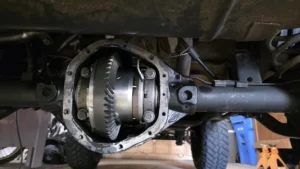
When it comes to vehicle performance and off-road capability, the differential is often the unsung hero of the drivetrain. For many drivers, the standard “open” differential is the first bottleneck they encounter when pavement ends or horsepower increases. To solve this, the automotive world has developed several specialized solutions: the Power Lock Limited Slip Differential (LSD), the Torsen LSD, and the Electronic Locker (E-Locker).
Understanding the mechanical nuances between these systems is crucial for selecting the right upgrade. While the “Power Lock” name carries a certain mystique, it is essentially a specific, high-performance evolution of the Clutch-Type Limited Slip Differential. Because clutch-style systems are the most recognized form of traction control in the aftermarket, framing the Power Lock in this context helps demystify how it manages torque.
What is a Power Lock LSD?
To understand the Power Lock, you must first understand the clutch-type LSD. In a standard open differential, power always follows the path of least resistance. If one wheel is on ice, it spins uselessly while the wheel on dry pavement gets zero torque.
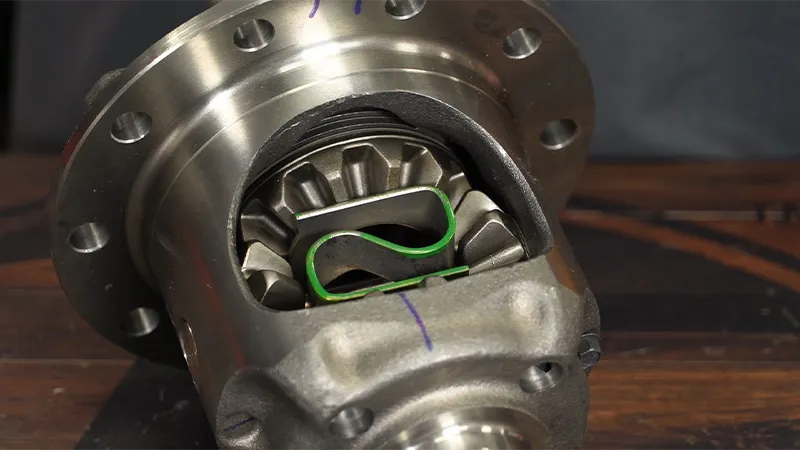
A Power Lock LSD solves this by using a stack of internal friction plates and steel discs (clutch packs) located behind the side gears.
How the Clutch Mechanism Works
In a Power Lock unit, the internal cross-shafts sit in V-shaped ramps. When you apply throttle, the torque forces these shafts to move up the ramps, which in turn exerts massive pressure on the clutch packs.
- The Locking Effect: As the clutches compress, they “bind” the two axle shafts together.
- The Result: Power is forced to the wheel with traction rather than being wasted on a spinning tire.
Because it uses physical friction plates, the Power Lock provides a very predictable and linear transfer of power. It is “active” the moment you hit the gas, making it a favorite for drag racing and traditional 4×4 builds where a rugged, mechanical feel is desired.
Power Lock (Clutch-Type) vs. Torsen LSD
If the Power Lock is the mechanical bruiser of the differential world, the Torsen (Torque-Sensing) differential is the precision instrument. While both are “Limited Slip,” they achieve traction through entirely different physics.
1. Mechanical Operation
Unlike the clutch-based Power Lock, a Torsen LSD uses a complex arrangement of helical planetary gears. There are no friction plates to wear out. Instead, it relies on the friction generated by the gears’ own thrust forces against the housing to move torque from the slipping wheel to the gripping one.
2. Driving Characteristics
- Torsen: Known for being incredibly smooth. It is virtually invisible during normal driving and does not require special gear oil additives. It is the gold standard for street-performance cars and modern SUVs where “chatter” or tire scrubbing is undesirable.
- Power Lock (Clutch): Can be more aggressive. Because it uses physical plates, it may “chatter” slightly during tight parking lot turns if not properly lubricated. However, it often provides a more “locked” feel under heavy acceleration compared to a Torsen.
3. Maintenance
A Torsen is essentially “fit and forget” because there are no wearable surfaces inside other than the gears themselves. A Power Lock, being a clutch-style unit, will eventually require a rebuild as the friction discs wear down over years of hard use.
Power Lock vs. E-Locker
For those who venture into extreme off-roading, the debate often shifts from Limited Slip to the Electronic Locker (E-Locker).
The E-Locker Advantage
An E-Locker is a selectable differential. At the push of a button, an electromagnetic mechanism physically locks the two axles together into a solid shaft.
- 100% Traction: Unlike a Power Lock LSD, which allows for some “slip” between the wheels to facilitate turning, an E-Locker allows for zero slip.
- On-Demand: You keep it “open” for normal street driving to save your tires, and only engage it when you see a massive mud hole or a rock wall ahead.
Why Choose a Power Lock Over an E-Locker?
The Power Lock (Clutch LSD) is an “always-on” automatic system. You don’t have to remember to flip a switch. For high-speed dirt racing or slippery highway driving (snow and rain), a Power Lock is often superior because it allows the vehicle to still navigate corners efficiently while providing extra grip. An E-Locker, if engaged on a high-traction surface, can make steering nearly impossible and put immense strain on the axles.
Performance Comparison Table
| Feature | Power Lock (Clutch LSD) | Torsen (Helical LSD) | E-Locker (Selectable) |
|---|---|---|---|
|
Main Mechanism |
Friction Clutch Packs |
Helical Gears |
Electromagnetic Pin/Plate |
|
Engagement |
Automatic (Torque-sensitive) |
Automatic (Instantaneous) |
Manual (Driver activated) |
|
Best For |
Muscle cars, classic 4x4s |
Road racing, daily drivers |
Rock crawling, deep mud |
|
Maintenance |
Requires friction modifier |
Standard gear oil |
Electrical wiring checks |
|
Wear Items |
Clutch plates wear out |
No wearable friction parts |
None (Mechanical lock) |
Why Understanding "Clutch-Type" Matters for Your Build
Many enthusiasts search for a “Power Lock” because of its legendary status in Dana axles and classic Jeep or truck builds. However, identifying it as a clutch-type differential is the key to understanding its performance profile.
If you want a differential that “bites” hard when you launch from a standstill, the clutch packs in a Power Lock are your best friend. The ability to “tune” these clutches by changing the plate stacking order or shim thickness gives builders a level of customization that Torsen or E-Locker units cannot match. You can effectively decide how much “slip” you want to allow before the unit locks up.
Conversely, if you value a maintenance-free life and smooth cornering on the street, the Torsen is likely your ideal candidate. And for the weekend warrior who needs a civilized street manners but wants to “tank” through obstacles on Sunday, the E-Locker is the ultimate upgrade.
Durability and Technical Longevity
The durability of these units depends largely on the manufacturing quality. In a Power Lock, the housing must be strong enough to withstand the “separating forces” of the cross-shafts. In a Torsen, the gear tolerances must be microscopic to prevent binding. In an E-Locker, the solenoids must be waterproof and shock-resistant.
When upgrading your drivetrain, always consider the quality of the metallurgy. A differential is under thousands of pounds of torque; using a factory-grade unit ensures that your gears won’t shear under pressure.
Conclusion
The “best” differential doesn’t exist in a vacuum; it depends entirely on how you use your vehicle. The Power Lock LSD offers a classic, rugged clutch-based performance that is easy to understand and tune. The Torsen LSD provides a modern, sophisticated, and maintenance-free experience for the performance driver. Finally, the E-Locker provides the raw, 100% locking power required for the most demanding off-road environments.
As a professional factory specializing in high-performance drivetrains, XJXPARTS offers premium Torsen LSDs and E-Lockers designed for maximum durability. Whether you need a smooth helical setup or a selectable locker, contact us for expert advice and factory-direct pricing to elevate your build.