Note: XJXParts is not related to any product or model code such as ‘xjx-400’, ‘xjx-212’, or other similar terms. Our focus is exclusively on differential and drivetrain technology.

Helical Limited Slip Differential vs Torsen: The Definitive Guide to Torque-Sensing Tech

In the world of performance engineering, traction is the currency of speed. Whether you are navigating a rain-slicked mountain pass or shaving tenths off a lap time, how your vehicle distributes power to the pavement determines your control. For many enthusiasts and mechanics, the debate often centers on the mechanical nuances of the helical limited slip differential vs torsen systems.

While these terms are often used interchangeably, understanding their mechanical differences and specific applications is essential for optimizing vehicle dynamics. This guide provides an in-depth technical analysis of these torque-sensing units to help you determine which is best for your build.
helical limited slip differential

Understanding the Torque-Sensing Architecture

Before diving into the “versus” aspect, it is vital to establish what these differentials are at their core. Both the helical limited slip differential and Torsen units fall under the category of Torque-Sensing (Parallel-Gear) hardware. Unlike traditional clutch-pack LSDs, which rely on friction plates and pre-load springs that eventually wear out, these units utilize complex gear geometry to manage torque.

What is a Helical Limited Slip Differential?

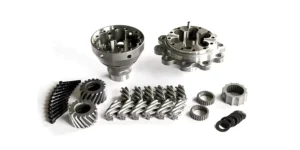
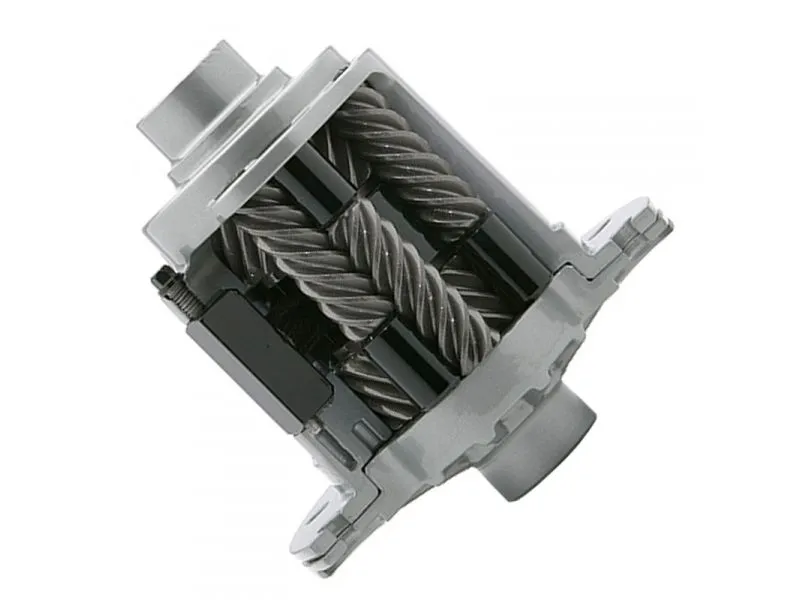
A helical limited slip differential uses sets of helical gears (gears with angled teeth) housed within the differential casing. When one wheel begins to lose traction, the axial and radial forces generated by these gears create friction against the housing. This friction “locks” the gears to a degree, transferring torque from the spinning wheel to the wheel with more grip.
For a more detailed breakdown of this technology’s internal mechanics, you can explore our comprehensive guide on:

What Is a Helical Limited Slip Differential?

Dive deep into helical LSD mechanics: learn how gear-based friction provides instant, maintenance-free traction for any road.

What is a Torsen LSD?

“Torsen” is a portmanteau of Torque-Sensing. While it is a brand name owned by the JTEKT Corporation, it has become the genericized trademark for this technology. When comparing a generic helical limited slip differential vs torsen, the latter specifically refers to Type A, B, or C variations using crossed-axis helical gears or planetary gear sets to achieve torque bias.

Mechanical Principles: How Torque Bias Works

The primary metric for evaluating these differentials is the Torque Bias Ratio (TBR). This represents the ratio of torque the differential can send to the wheel with more traction compared to the wheel with less traction.

The Physics of Gear Friction

In a standard open differential, torque is always split 50/50. If one wheel is on ice, it can only support 5 Nm of torque before spinning; consequently, the wheel on dry pavement also only receives 5 Nm, leaving you stranded.
A helical or Torsen unit changes this. As the input torque increases, the angled teeth of the helical gears are pushed against the internal walls of the differential. This creates mechanical resistance. If a unit has a TBR of 3:1, it can send three times as much torque to the high-traction wheel as the low-traction wheel.

Instantaneous Response

One of the greatest advantages of the helical design is that it is purely mechanical. There is no “activation time” as seen with viscous couplings or electronic actuators. The torque transfer is instantaneous and proportional to the input, providing a seamless transition from off-throttle to on-throttle cornering.

Helical Limited Slip Differential vs Torsen

While both systems operate on the principle of crossed-axis or parallel helical gears to generate internal friction, the nuanced differences in their mechanical execution significantly impact how they handle stress, power delivery, and driver feedback. When evaluating a helical limited slip differential vs torsen, it is essential to analyze the specific performance vectors that define their behavior.

Torque Bias Ratio (TBR) and Distribution Efficiency

The primary performance metric in the helical limited slip differential vs torsen comparison is the Torque Bias Ratio. The TBR determines how much more torque can be sent to the wheel with grip versus the wheel that is slipping.

While the Torsen system (particularly the Type A) was historically known for achieving higher bias ratios through its crossed-axis gear geometry, modern helical limited slip differentials have bridged this gap. High-performance helical units now offer finely tuned TBRs (typically between 2.5:1 and 3.5:1), providing enough locking force for competitive track use while maintaining enough flexibility for street maneuvers.

Engagement Smoothness and Driver Feedback

One area where the helical limited slip differential often excels is in the linearity of its engagement. Because the torque transfer is a direct function of input torque and gear friction against the housing, the transition is seamless.
In high-performance FWD applications, this smoothness is critical. Unlike some Torsen units that may feel more binary or “on-off” when they find grip, a well-engineered helical unit allows the driver to modulate the throttle with extreme precision. This reduces mid-corner corrections and allows for an earlier apex exit.

Noise, Vibration, and Harshness (NVH) Comparison

For a vehicle that serves dual duty as a daily driver and a track toy, NVH is a major consideration. Both gear-type systems are significantly quieter than clutch-type LSDs, but the parallel-gear arrangement of the helical limited slip differential is generally considered the industry benchmark for refinement.
The Torsen design, due to its complex gear intersections, can sometimes produce a faint mechanical “whir” under heavy load or deceleration in certain AWD configurations. The helical design remains virtually silent, behaving like a standard open differential during low-speed maneuvers and parking.

Comparative Technical Analysis: At-a-Glance

To help you visualize the technical distinctions, the following table breaks down the core attributes of the helical limited slip differential vs torsen architectures:
Feature Helical Limited Slip Differential (Parallel) Torsen (Type A/B/C)
Gear Arrangement
Parallel axis helical gears
Crossed-axis or planetary gears
Locking Action
Progressive and highly linear
Instantaneous and firm
Common Application
FWD/RWD sports cars, hot hatches
Center AWD units, heavy-duty RWD
Durability
Zero wear-prone parts; extremely long life
High; robust complex geometry
NVH Levels
Silent (OE standard)
Generally silent; occasional gear whir
Maintenance
Standard gear oil; no additives
Typical TBR Range
2.0:1 to 3.5:1
2.5:1 to 4.5:1

Thermal Management and Endurance Stability

In high-intensity environments—such as 30-minute track sessions—thermal management is what separates a street component from a race-ready one. Both the helical limited slip differential and Torsen units rely on the surface area between the gears and the differential housing to dissipate heat.

The advantage of the helical design lies in its relative simplicity, which often allows for more efficient oil circulation within the carrier. This ensures that the lubricating film remains intact even as temperatures rise, preventing “torque fade.” When choosing between a helical limited slip differential vs torsen, both demonstrate superior thermal stability over viscous units, as they do not rely on fluid shear to function.

Application Guide: Which One Fits Your Build?

Choosing the right differential depends largely on your vehicle’s drivetrain layout and intended use.

Front-Wheel Drive (FWD)

For FWD applications, the helical limited slip differential is the undisputed king. It allows for aggressive corner-exit acceleration without the heavy steering kickback associated with other performance differentials.

Rear-Wheel Drive (RWD)

In RWD sports cars, both provide excellent mid-corner stability. They are particularly effective for “canyon carving” where smooth, maintenance-free operation is prioritized.

All-Wheel Drive (AWD)

Many iconic AWD systems use Torsen differentials as center units. They excel at managing front-to-rear torque split, ensuring power is diverted to the axle with the most weight transfer.

Technical Specifications: What to Look For

When sourcing a differential, pay close attention to the manufacturing quality. A high-performance unit should feature:
  • Forged Steel Housing: To resist deflection under high torque loads.
  • Precision CNC Machining: Ensuring consistent friction and locking force.
  • Heat Treatment: Essential for gear longevity in high-horsepower applications.

The Engineer’s Choice for Reliability

In the modern automotive landscape, the shift toward gear-driven LSDs is clear. By utilizing the natural laws of friction and gear geometry, these differentials provide a “smart” torque distribution that adapts to the road surface in real-time. Whether you are analyzing a helical limited slip differential vs torsen for a track build or a daily driver, the upgrade offers a level of refinement that clutch-based systems cannot match.

When upgrading your drivetrain, the quality of the gears and housing is non-negotiable. At XJXPARTS, we specialize in the precision manufacturing of automotive drivetrain components. As a direct-to-market factory, we provide high-performance differentials and gear sets engineered to meet rigorous international standards. If you are looking for reliable transmission solutions or custom manufacturing, please contact us to discuss your requirements with our technical team.

Don’t Stop Here

More To Explore

do-you-need-an-e-locker-differential

Do You Need an E-Locker Differential?

For many drivers exploring off-road capability, the idea of upgrading to a locking differential—especially an electronic locking differential (E-locker)—comes up quickly. It’s often described as

download catalog now!