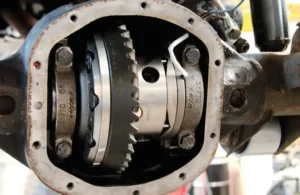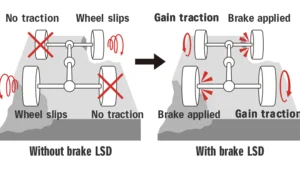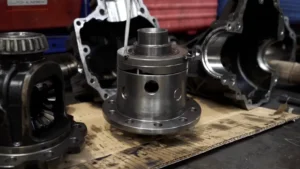
When you inspect a differential housing, you might notice a thin, gear-shaped ring mounted behind the crown wheel. This is the ABS tone ring, also known as a reluctor ring or speed sensing ring. Despite its small size and simple appearance, it plays a crucial role in modern vehicle safety systems, providing accurate wheel speed information to the ABS, traction control, and stability control systems.
What Is an ABS Tone Ring?

The ABS tone ring is a precisely machined metal ring with evenly spaced teeth around its circumference. Its purpose is not to transfer power but to generate a wheel speed signal. As the differential rotates, the teeth on the tone ring pass by a nearby ABS sensor, producing a series of electrical pulses. These pulses are interpreted by the vehicle’s ECU to determine the rotation speed of the wheels in real time. A properly functioning tone ring ensures that ABS and related systems operate accurately and reliably.
Why Is It Mounted Inside the Differential?

Many vehicles place the tone ring inside the differential rather than on individual wheel hubs. This design choice offers several advantages. First, it allows a single rear ABS sensor to measure both rear wheels on vehicles where cost or space constraints prevent dual sensors. Second, positioning the tone ring inside the differential protects it from debris, mud, snow, and other external hazards that could damage an exposed ring. Third, the differential carrier provides a stable, low-vibration platform, ensuring accurate signals even when wheels move over rough terrain. Finally, this configuration reduces wiring complexity and manufacturing costs while maintaining performance and reliability.
How the ABS Tone Ring Works?
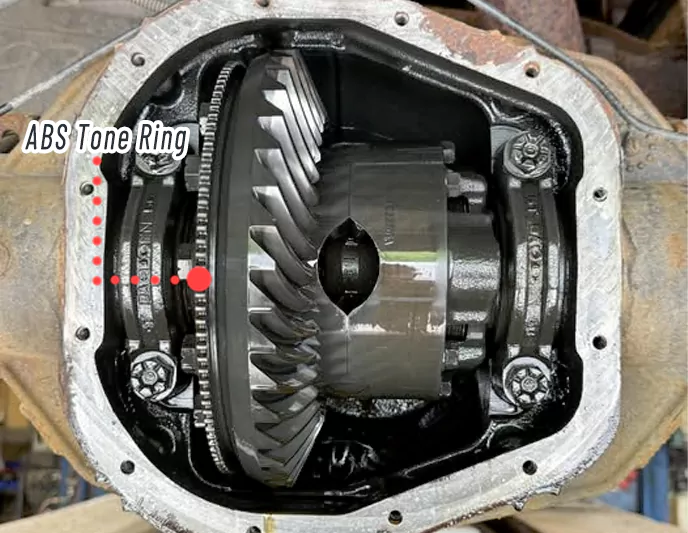
The operation of the ABS tone ring depends on its interaction with the ABS sensor. As the differential carrier rotates, the tone ring spins along with it. The sensor is positioned very close to the teeth through a window in the axle housing. When a tooth passes the sensor, it creates a magnetic field change that produces an electrical pulse. Each tooth generates one pulse, and the spacing of the teeth determines the resolution of the wheel speed measurement. If teeth are damaged, bent, or missing, the pulse pattern becomes irregular, causing ABS, traction control, or stability systems to malfunction.
Common Failures and Symptoms
- Corrosion from moisture in the gear oil
- Cracked or broken teeth from age or mechanical stress
- Bent or warped rings caused by improper handling or installation
- Loosened press-fit rings due to wear or previous repairs
- Excessive sensor-to-ring gap due to bearing wear
When a tone ring fails, typical symptoms include ABS warning lights, traction control or stability control deactivation, erratic speedometer readings, unexpected ABS activation at low speeds, and diagnostic trouble codes related to wheel speed. Often, these issues are misdiagnosed as a faulty sensor when the underlying problem is a damaged tone ring inside the differential.
Replacement and Installation Considerations
Replacing a differential-mounted ABS tone ring requires precision. Most vehicles use a press-fit ring that must be carefully heated and installed on the differential carrier. The tooth count must match the original, and the ring must be oriented correctly. Any debris or scratches on the seating surface can affect sensor readings. After installation, the air gap between the ring and sensor must be measured to ensure proper function. Some performance or off-road vehicles may use bolt-on tone rings, which simplify replacement but are less common.
Conclusion
Even though the ABS tone ring inside a differential is just a small metal ring, it quietly does a huge job. It tells the ABS and traction systems exactly how fast your wheels are spinning, which keeps your braking smooth and your car stable. When the ring wears out, gets bent, or corrodes, the problems aren’t always obvious until the warning lights come on or braking feels off. Knowing how it works and keeping it in good shape can save a lot of headaches and keep your car running safely and reliably.
XJXPARTS is a professional manufacturer specializing in high-quality limited-slip differentials, offering reliable solutions for enhanced traction and vehicle performance. If you would like to learn more about our products or discuss your specific needs, please do not hesitate to contact us.