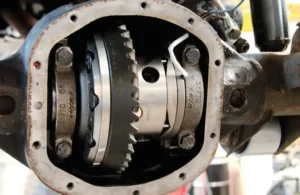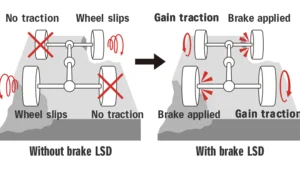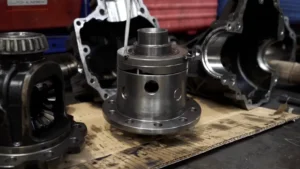
What is Detroit Locker

How It Works
Advantages of the Detroit Locker
- Unmatched Durability: With no hoses, wires, or internal solenoids, there is very little that can fail. It is a “set it and forget it” component.
- Hands-Free Operation: The driver does not need to anticipate an obstacle. The locker is always ready to provide 100% torque transfer.
- Strength: The internal gear design is significantly stronger than most factory spider gears, making it ideal for vehicles running oversized tires.
Disadvantages and Road Manners
The Elocker: Precision Control at Your Fingertips
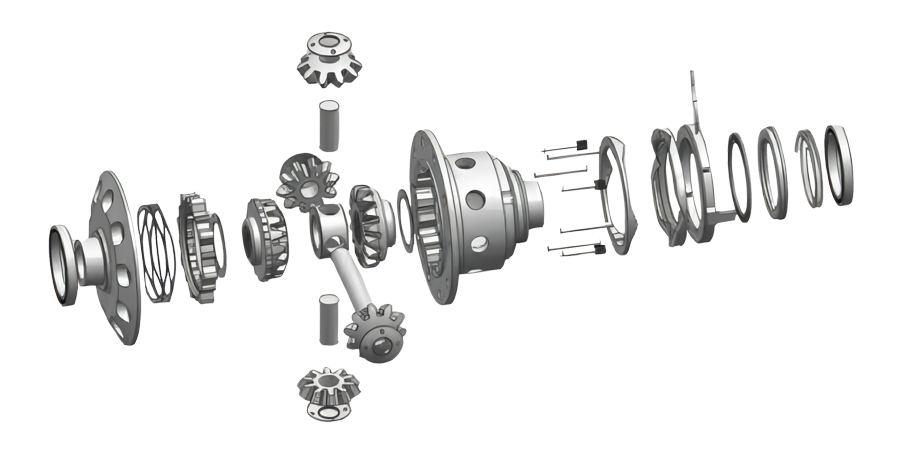
How It Works
Advantages of the Elocker
- Selectability: This is Elocker’s greatest strength. On the highway, your vehicle handles exactly like stock. Off-road, it becomes a true locker only when you need it.
- Safety on Low-Traction Surfaces: For those living in snowy climates, the ability to keep the differential “open” while driving on icy highways provides much better stability and steering control than an automatic locker.
- Quiet Operation: There are no ratcheting sounds or mechanical pops during tight turns in a parking lot.
Disadvantages of the Elocker
- Complexity: The system relies on an electrical circuit. If a wire is snagged by a branch or a fuse blows, you lose your locking capability.
- Engagement Lag: Unlike a Detroit Locker, which is always ready, an ELocker requires the driver to stop or slow down and engage the switch before hitting the obstacle. Some units also require a small amount of wheel rotation for the locking pins to align and seat.
Technical Comparison: Durability and Maintenance
Maintenance Requirements
The Detroit Locker is incredibly low-maintenance. It uses standard gear oil (though most manufacturers recommend staying away from friction modifiers used in limited-slip units). Because it is a purely mechanical gear-driven unit, there are no seals to leak or magnets to burn out.
The Elocker requires a bit more oversight. While the internal gears are robust, the external wiring harness must be inspected periodically for damage. Furthermore, the electromagnet requires clean oil to function optimally; metal shavings in the differential fluid can occasionally interfere with the magnetic engagement over many years of use.
Strength Comparison
In terms of sheer torque capacity, the Detroit Locker generally takes the lead in extreme applications. It is often the choice for 1-ton axle builds (like the Dana 60 or Corporate 14-bolt) used in professional rock crawling. However, modern Elockers have closed this gap significantly. Current four-pinion Elocker designs are more than capable of handling 37-inch to 40-inch tires in most recreational off-roading scenarios.
Application Guide: Which One Should You Buy?
Choose a Detroit Locker if:
- It is a dedicated trail rig or race car: If the vehicle is rarely driven on the street, the mechanical quirks are irrelevant, and the “always-on” reliability is a massive asset.
- You want the simplest setup: If you hate dealing with wiring, relays, and switches, the mechanical simplicity of the Detroit is unbeatable.
- Heavy Towing: For trucks that frequently haul heavy loads on loose surfaces (like boat ramps or farm fields), the automatic engagement ensures you never lose momentum.
Choose an ELocker if:
- It is your Daily Driver: If you take your kids to school and commute to work in the same vehicle you take to the trails, the ELocker is the superior choice for comfort and safety.
- You drive in Snow and Ice: Selectable lockers are far safer on winter roads. An automatic locker can cause a vehicle to “fishtail” when both tires spin at the same speed on a slippery curve.
- Precision Maneuvering: In tight woods where you need to turn sharply, being able to unlock the differential allows for a much tighter turning radius than a ratcheting Detroit Locker.
Installation Considerations
Both units require a professional-level installation. Installing a locker involves “setting the gears,” which means shimming the differential to achieve the correct backlash and pinion depth.
- Detroit Locker: Requires standard differential setup. No additional holes need to be drilled in the axle housing.
- Elocker: Requires the installer to drill and tap a small hole in the axle housing to run the electrical bulkhead connector. You must also route a wiring harness from the axle to the battery and into the cabin for the switch.
Failure to set the gear pattern correctly in either unit will lead to premature failure of the ring and pinion, regardless of how strong the locker itself is.
Summary Table: Detroit Locker vs. Elocker
| Feature | Detroit Locker | Elocker Diff |
|---|---|---|
|
Operation |
Automatic (Mechanical) |
Selectable (Electronic) |
|
Street Manners |
Noticeable (Clunks/Pops) |
Transparent (Like Stock) |
|
Reliability |
Extremely High (Few failure points) |
High (Requires intact wiring) |
|
Icy Road Safety |
Low (Predictability issues) |
High (Can remain open) |
|
Engagement |
Immediate/Speed Sensing |
Manual Switch |
|
Best Use Case |
Hardcore Off-road / Heavy Work |
Daily Driver / Weekend Warrior |
Final Thoughts on Traction Upgrades
Contact XJXPARTS Today for expert advice and factory-direct pricing on premium drivetrain solutions.