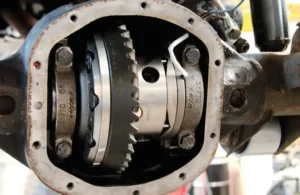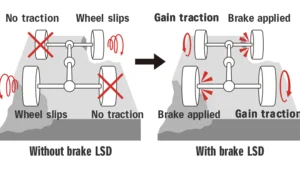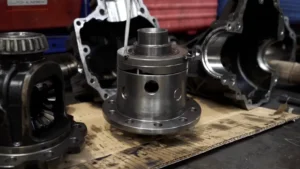
In drifting, a differential is rarely defined by how it behaves at full throttle. What actually separates a good setup from a frustrating one happens earlier—during corner entry, during transitions, and during that brief moment when the car is neither fully on power nor fully off it. That is where preload matters, and that is why it deserves far more attention than it usually gets.

A drift car that feels predictable in these moments is easier to drive at the limit. One that doesn’t will always feel like it needs to be forced.
Open Differentials
With an open differential, things feel acceptable only as long as both rear tires are equally loaded. The moment one tire unloads, drive disappears. Initiation becomes inconsistent, throttle response feels delayed, and the rear of the car never truly feels connected.
The key issue is that an open diff reacts after traction is already lost. In drifting, that delay is enough to break confidence.
Spools and Welded Diffs
A spool or welded differential removes uncertainty by eliminating differentiation altogether. Both rear wheels are permanently locked, which gives immediate and consistent response on track.
That predictability is useful, especially for drifting, but it comes at a cost. Corner entry becomes heavier, transitions require more effort, and the car resists rotation more than necessary. It works, but it works by brute force rather than balance.
Torsen Differentials
A Torsen differential is extremely effective in grip driving. It biases torque smoothly and intelligently, but it does not lock. More importantly, it requires load on both wheels to function.
During drift initiation or at high angle, that condition often disappears. When one wheel goes light, the Torsen’s ability to transfer torque drops sharply. From the driver’s seat, this feels like hesitation at exactly the wrong moment.
During drift initiation or at high angle, that condition often disappears. When one wheel goes light, the Torsen’s ability to transfer torque drops sharply. From the driver’s seat, this feels like hesitation at exactly the wrong moment.
Why Clutch-Based LSDs Dominate Drifting?
This is why clutch-based limited slip differentials are so common in drift cars. Not because they are more aggressive, but because they allow control over when locking begins.
Most discussions focus on acceleration and deceleration locking. Those settings matter, but they only apply once throttle or braking is clearly involved. Preload is different. It is always present.
What Preload Actually Controls on Track?
Preload defines how the differential behaves before the driver asks for power. It determines whether the rear axle feels settled on entry or disconnected, whether transitions feel fluid or awkward, and whether the car responds immediately or needs to be forced.
Preload defines how the differential behaves before the driver asks for power. It determines whether the rear axle feels settled on entry or disconnected, whether transitions feel fluid or awkward, and whether the car responds immediately or needs to be forced.
What preload really controls is confidence.
That short phase between lifting the throttle, initiating the slide, and getting back on power is where drift cars either feel natural or difficult. Acceleration lock does not define that moment, because the car is not yet under power. Deceleration lock does not fully explain it either.
Preload does.
This is why two differentials with identical locking percentages can feel completely different on track. One feels predictable and easy to place, while the other feels nervous or stubborn, simply because the preload is wrong.
A well-set preload does not mean maximum lock. It means the rear wheels are already working together before power is applied, without preventing the car from rotating freely.
When preload is right, initiation requires less effort, transitions become cleaner, and throttle corrections feel natural. Once that foundation is correct, other differential settings become easier to understand and tune.
What Preload Actually Controls on Track?
In drifting, a differential should not be judged by how hard it locks at full throttle. It should be judged by how it behaves before that point. Preload is not a finishing touch at the end of a setup. It is the base everything else depends on.
Preload is not a finishing touch at the end of a setup. It is the base everything else depends on. Get preload right, and the car starts to make sense. Get it wrong, and no amount of adjustment elsewhere will fully fix the way the car feels.