If you’ve ever driven a 4WD truck or SUV, you’ve probably noticed the 2H, 4H, and 4L settings near the gear selector. Most drivers know these modes have something to do with four-wheel drive, but knowing exactly when to use them isn’t always straightforward.
Should you switch to 4H when driving through snow? Is 4L better for muddy roads? And can you use 4H on the highway?
These are common questions, especially for drivers who are new to off-roading.
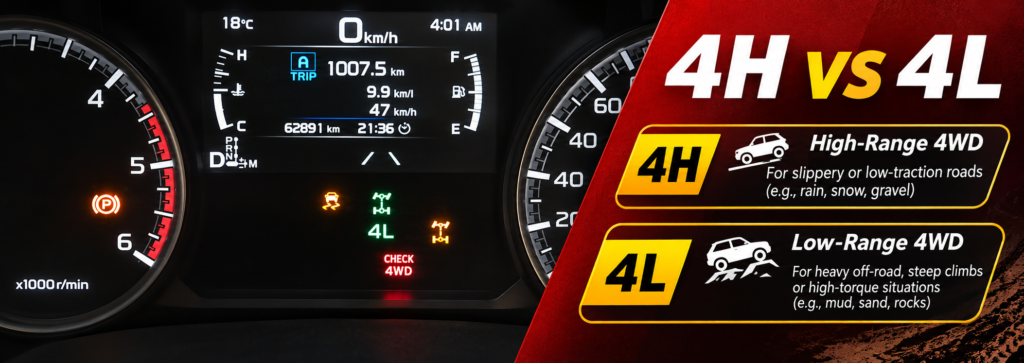
The difference between 4H and 4L comes down to how the vehicle delivers power to its wheels. Both modes can drive all four wheels, but they’re designed for different driving conditions.
Let’s look at how they work and, more importantly, when you should use each one.
Before comparing 4H and 4L, it helps to understand how a part-time four-wheel-drive system works.
Unlike full-time AWD systems, which can automatically distribute power between the front and rear wheels, a traditional part-time 4WD system allows the driver to select between two-wheel drive and four-wheel drive.
The system uses a component called the transfer case to deliver engine power to the front and rear axles.
Most part-time 4WD trucks and SUVs offer three main settings:
The main difference between 4H and 4L is the gear ratio inside the transfer case.
In 4H, the transfer case operates in its high range, usually with a ratio close to 1:1. This allows the vehicle to maintain a wider range of driving speeds while powering both axles.
In 4L, the transfer case engages a reduction gear. This multiplies the torque delivered through the drivetrain while reducing wheel speed at a given engine RPM.
For example, imagine a 4WD vehicle with a 2.5:1 low-range transfer case ratio. At the same engine speed and transmission gear, engaging 4L can provide approximately 2.5 times the wheel torque compared with 4H, before accounting for drivetrain losses.
The engine itself isn’t suddenly producing more torque. The extra pulling force comes from mechanical gear reduction.
That distinction matters when you’re climbing a steep trail, crawling over rocks, or trying to move a heavily loaded vehicle through difficult terrain.
Neither setting is automatically better than the other. The right choice depends on the terrain, traction available, and how much control the driver needs.
For everyday off-road driving, 4H is usually the more practical option.
It gives the vehicle four-wheel-drive traction without limiting it to the slower speeds associated with low-range gearing.
Here are some situations where 4H makes sense.
Snow is one of the most common situations where drivers use 4H.
When the road is slippery, sending power to both axles can help the vehicle accelerate and maintain forward movement without relying entirely on one driven axle.
For example, if you’re driving a pickup truck on a snow-covered mountain road, 4H may help reduce wheelspin when accelerating or climbing a gentle slope.
However, 4WD does not improve braking performance by itself. Your tires, speed, and road conditions still determine how safely you can stop or turn.
On patchy snow or icy roads where exposed dry pavement appears, check your vehicle’s owner’s manual before using part-time 4H.
Gravel roads can become slippery, especially when the surface is uneven or covered with loose stones.
In these conditions, 4H can help distribute driving force between the front and rear axles.
This is particularly useful for pickup trucks carrying cargo or traveling on unpaved mountain roads.
You may still be able to drive in 2H, but switching to 4H can provide better traction when the surface becomes loose.
Not every muddy road requires 4L.
If the mud is relatively shallow and the vehicle can maintain steady forward movement, 4H is often enough.
In fact, using excessive throttle in 4L can sometimes make wheelspin worse, especially when the tires have limited grip.
The key is to maintain appropriate momentum without spinning the wheels unnecessarily.
If the mud becomes deeper, the vehicle starts struggling, or you need very slow and controlled movement, 4L may become the better choice.
On firm or moderately loose sand, 4H can help maintain steady momentum.
This is why many drivers prefer 4H when traveling along open sandy tracks where they don’t need to crawl over obstacles.
However, soft sand is not always a 4H-only situation. Deep sand, steep dunes, or heavy vehicle loads may require 4L.
Tire pressure, vehicle weight, and driving technique also make a major difference.
While 4H is designed for general traction, 4L is intended for situations where the vehicle needs more torque at lower speeds.
Think of 4L as the setting you choose when moving slowly and maintaining control matters more than maintaining speed.
Imagine you’re approaching a steep, rocky slope.
In 4H, the engine may struggle to maintain a comfortable speed in the selected gear. You might need more throttle or clutch slip to keep moving.
Switching to 4L allows the vehicle to climb at a slower speed while delivering greater wheel torque.
This makes it easier to approach obstacles carefully without forcing the engine to work at very low RPM.
Rock crawling is one of the clearest examples of why low-range gearing exists.
When driving over large rocks, you don’t want the vehicle suddenly jumping forward every time you press the accelerator.
You need precise throttle response, controlled wheel movement, and enough torque to climb obstacles.
4L allows the engine to operate within a useful RPM range while the wheels turn slowly.
It also helps the driver make small adjustments when navigating uneven ground.
Deep mud is different from a lightly muddy road.
When the tires sink into soft ground or the vehicle must climb out of deep ruts, it may take considerable torque to keep moving.
4L can help in these situations, particularly when controlled movement is needed.
However, more torque doesn’t automatically mean better traction. If the tires cannot grip the ground, they may simply spin faster.
Sometimes 4H and momentum work better; other times 4L and careful throttle control are the safer choice.
Many drivers associate 4L only with climbing, but it is also useful when descending steep terrain.
Low-range gearing provides stronger engine braking, helping control vehicle speed without relying entirely on the service brakes.
On a long, rocky downhill section, this can make the vehicle easier to manage.
Of course, you should still follow the manufacturer’s recommended gear selection and use hill descent control if your vehicle is equipped with it.
This is one of the biggest misunderstandings surrounding four-wheel-drive systems.
The word “high” in 4H refers to the transfer case’s high gear range. It does not mean that 4H is specifically designed for high-speed highway driving.
For traditional part-time 4WD vehicles without a center differential, using 4H on dry pavement can create drivetrain binding.
When a vehicle turns, the front and rear axles naturally need to rotate at slightly different average speeds.
On loose terrain, the tires can slip enough to accommodate those differences.
But on dry pavement with strong traction, the drivetrain may not be able to release that tension easily.
Over time, this can place unnecessary stress on the transfer case, driveshafts, axles, and other components.
For traditional part-time 4WD vehicles, 2H is generally the correct setting for dry, high-traction paved roads.
Some modern vehicles offer full-time 4WD, automatic 4WD, or a separate 4A mode that is designed to work on paved roads. Always check the specific vehicle’s operating instructions.
That depends on which mode you’re selecting and the vehicle’s transfer case design.
Many modern part-time 4WD vehicles allow drivers to switch between 2H and 4H while moving, provided they stay within the manufacturer’s specified speed limits.
If you’re still unsure which mode to use, think about what the vehicle needs most.
When you need additional traction while maintaining reasonable driving speed on a loose surface, 4H is usually the starting point.
When you need to move slowly, climb difficult obstacles, or maintain precise control over the vehicle, 4L is generally more appropriate.
Here’s a quick reference:
These are general recommendations for traditional part-time 4WD vehicles. Actual operating requirements vary by manufacturer, transfer case, tires, and terrain.
4H helps your vehicle put power to the ground when traction is limited. It’s generally the better option for snow, gravel, light mud, and loose dirt roads.
4H helps your vehicle put power to the ground when traction is limited. It’s generally the better option for snow, gravel, light mud, and loose dirt roads.
Choosing the right 4WD mode for the terrain is one of the simplest ways to improve control, reduce unnecessary drivetrain stress, and get more out of your truck or SUV.
And remember, your transfer case is only one part of the four-wheel-drive system. Tires, axle gearing, differential design, and driving technique all influence how well your vehicle performs off-road.
Choosing the right 4WD mode for the terrain is one of the simplest ways to improve control, reduce unnecessary drivetrain stress, and get more out of your truck or SUV.