If you’re planning to install an air locker on your 4×4, you’ve probably spent some time thinking about the locker itself. But there’s another question that deserves attention: where should you mount the air compressor?
It’s a topic that comes up quite often among 4×4 owners, especially when it comes to vehicles like the Toyota Tacoma, Hilux, Land Cruiser, and Nissan Patrol.
Some people prefer to install the compressor under the hood. Others put it under a passenger seat or inside the rear cargo area. Each option has its advantages, and none is perfect for every vehicle.
So, before you start drilling holes or making mounting brackets, let’s look at the common options and the practical issues worth considering.
1. Under the Hood
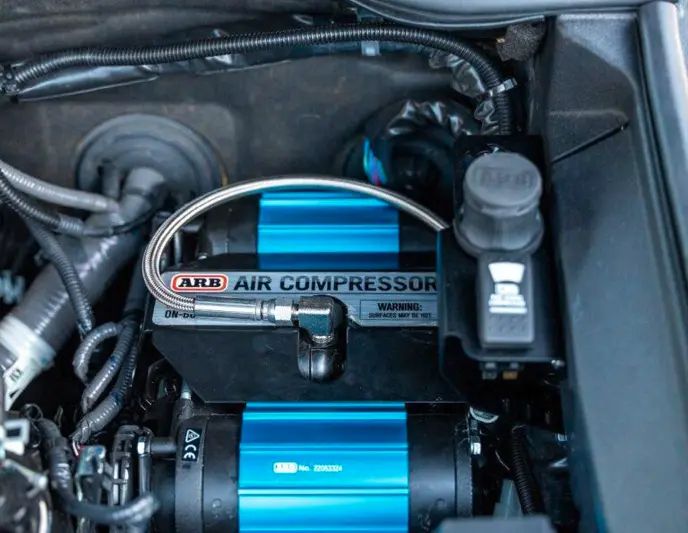
For many 4×4 owners, mounting an air locker compressor in the engine bay is the most straightforward option.
There’s usually no need to run additional wiring deep into the cabin, and the compressor can be relatively easy to access for maintenance. With a suitable mounting bracket, the installation can also look clean and well organized.
However, engine heat is a reasonable concern.
The engine bay can become very hot, particularly during slow off-road driving or when the vehicle is working hard. The actual temperature around the compressor depends on its position, the vehicle’s layout, and airflow.
That doesn’t mean an under-hood installation is automatically a bad idea. It means you need to choose the location carefully.
Keep the compressor away from exhaust components and other significant heat sources. Check the manufacturer’s recommended operating temperature, mounting requirements, and ventilation guidelines before deciding where it should go.
Water exposure is another consideration. Although the engine bay offers some protection, it isn’t completely sealed against rain, splashes, or mud.
Best for: Drivers who want a compact installation with convenient access and have enough suitable space under the hood.
2. Under the Passenger Seat
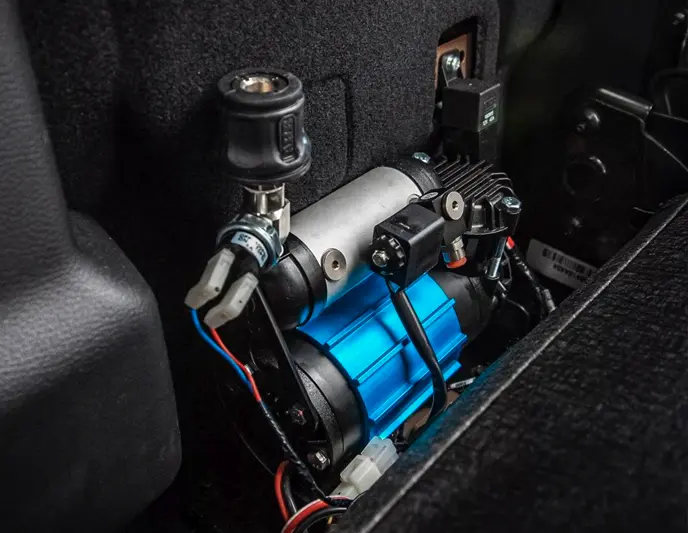
If you’ve ever looked at the space under a passenger seat and thought it was going to waste, you’re not alone.
Some 4×4 owners choose this location because it keeps the compressor out of the engine bay and helps protect it from direct exposure to mud, dust, and water.
It can also make good use of otherwise unused space, particularly in vehicles where the engine bay is already crowded with other equipment.
But there’s one drawback worth thinking about before choosing this air locker compressor mounting location: noise.
When the compressor operates inside the cabin, you may hear it more clearly than you would if it were mounted outside. This can be particularly noticeable when using an air locker during a trail drive.
Some installations may also interfere with passenger-seat movement or door clearance, depending on the vehicle and mounting arrangement.
Before committing to this setup, check the available space carefully. Make sure the seat can move through its full range, the door closes properly, and the compressor has sufficient ventilation.
Also, don’t assume that placing the compressor inside the cabin automatically makes it waterproof or maintenance-free. Moisture, condensation, and heat still need to be considered.
Best for: Builds where exterior mounting space is limited and the owner prioritizes protection from direct environmental exposure.
3. In the Truck Bed or Rear Cargo Area
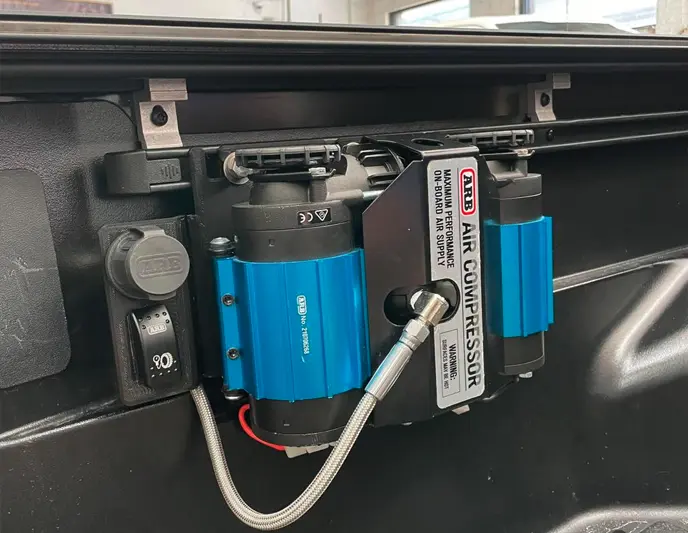
For pickup trucks and other 4x4s with suitable storage areas, the rear cargo area can be another practical option.
Some owners prefer this arrangement because it keeps the compressor away from engine heat and passenger noise. It may also leave more room for other equipment under the hood.
A dedicated storage compartment or protected bed cubby can make the installation especially tidy.
However, there’s a difference between mounting a compressor inside a protected compartment and simply bolting it onto an exposed section of the truck bed.
Rain, dust, mud, and cargo can all become problems if the unit isn’t adequately protected. A compressor mounted in an exposed location may need additional shielding or a properly designed enclosure, provided that cooling and ventilation requirements are still met.
Think about how you actually use your truck. If you regularly carry tools, camping gear, or other heavy equipment, the compressor needs to be protected from accidental impacts.
You’ll also want to plan the wiring and air lines before installation, particularly if the system needs to supply a locker at the front axle.
Best for: Pickup owners and custom 4×4 builds with enough protected cargo space and a well-planned mounting arrangement.
4. Behind the Front Grille
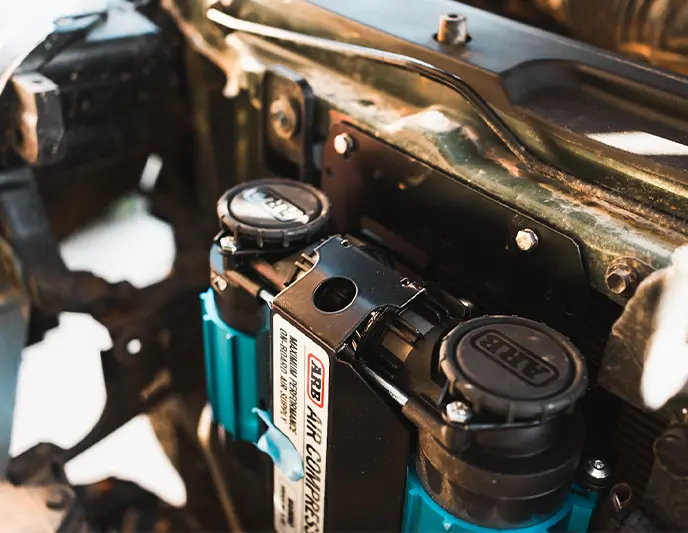
Another option is to mount the compressor behind the grille.
This can keep the equipment outside the passenger cabin while making use of space near the front of the vehicle. For some builds, it may be a reasonable alternative when the engine bay is crowded.
The main challenge is available space.
If your vehicle already has a winch, auxiliary lighting, or other off-road accessories, fitting a compressor behind the grille can become difficult. You also need to consider water exposure, airflow, heat from nearby components, and access for future maintenance.
A location that looks convenient during installation may become frustrating later if you have to remove other equipment just to service the compressor.
As with any mounting option, check the compressor’s environmental and operating requirements before choosing this position.
Best for: Custom builds with sufficient clearance and a suitable way to protect the compressor without restricting airflow.
Where Is the Best Place to Mount an Air Locker Compressor?
There isn’t one answer that works for every 4×4.
Here’s a quick comparison of the most common locations:
| Mounting Location | Main Advantage | Main Consideration |
|---|---|---|
|
Engine bay |
Convenient access and compact installation |
Heat and available space |
|
Under passenger seat |
Uses otherwise unused cabin space |
Noise, ventilation, and seat clearance |
|
Truck bed or cargo area |
More flexibility for custom installations |
Weather, dust, and cargo protection |
|
Behind the grille |
Can free up space elsewhere |
Limited clearance and exposure to the elements |
The right choice depends on your vehicle, the compressor you’re using, and how you intend to use your 4×4.
For many installations, the engine bay is a sensible starting point. If space is limited or heat exposure is a concern, a protected cargo area or another suitable location may work better. An under-seat installation can also be practical when cabin noise and ventilation are properly addressed.
Before making a decision, consider how often the compressor will run, how the vehicle is used off-road, and how easy the unit will be to inspect and maintain.
A well-planned installation isn’t just about finding an empty space. It’s about choosing a location that works reliably in real driving conditions.
Looking for Air Lockers for Your 4x4 Applications?
Choosing the right compressor location is one part of building a reliable air locker system. Vehicle compatibility, differential specifications, installation requirements, and component quality matter just as much.
We manufacture differential products for 4×4 applications and support wholesale supply for distributors, off-road workshops, and automotive parts businesses.
Contact our team to discuss air locker models, vehicle applications, and wholesale supply options.