The Toyota Hilux is one of the world’s most recognized pickup trucks, with a history spanning more than five decades. Since its introduction in 1968, it has evolved through multiple generations, with different chassis codes, engine configurations, body styles, and drivetrain systems.
For Toyota Hilux owners, off-road enthusiasts, mechanics, and automotive parts buyers, understanding these model codes is important when identifying the correct vehicle and selecting compatible replacement parts.
You may have come across codes such as LN106, LN107, LN167, KUN26, and GUN126, or market-specific names such as N70, Vigo, and Revo.
But what do these codes mean? Which generation does each model belong to? Are N70 and KUN26 the same vehicle? And how can you identify the correct differential locker for your Hilux?
In this guide, we explain all nine Toyota Hilux generations, commonly encountered chassis codes, engine prefixes, and the differences between popular models. We also explain what information you need to identify the correct differential locker for your vehicle.
Understanding Toyota Hilux Chassis Codes
Before exploring individual generations, it is important to understand how Toyota identifies its Hilux models.
Toyota uses specific model codes to distinguish different vehicle configurations. These codes are commonly found on the manufacturer’s identification plate, frame number, vehicle registration documents, and Toyota parts catalogs.
Examples include:
- LN106
- LN107
- LN167
- KUN26
- GUN126
- TGN126
These codes are not generation numbers. They identify particular vehicle models or configurations within a broader Hilux family.
What Do LN, KUN, GUN, RN, and TGN Mean?
The letter combinations are associated with Toyota’s engine and vehicle model coding systems.
Here are some common prefixes found on Toyota Hilux models:
| Prefix | Common engine family | Typical engine codes | Fuel type |
|---|---|---|---|
|
LN |
L-series |
2L, 3L, 5L |
Diesel |
|
KUN |
KD-series |
1KD-FTV, 2KD-FTV |
Diesel |
|
GUN |
GD-series |
1GD-FTV, 2GD-FTV |
Diesel |
|
KDN |
KD-series |
1KD-FTV, 2KD-FTV |
Diesel |
|
RN |
R-series |
18R, 22R, 2RZ |
Petrol |
|
YN |
Y-series |
2Y, 3Y, 4Y |
Petrol |
|
TGN |
TR-series |
1TR-FE, 2TR-FE |
Petrol |
|
GGN |
GR-series |
1GR-FE |
Petrol |
|
RZN |
RZ-series |
1RZ, 2RZ, 3RZ |
Petrol |
These are common associations rather than a universal character-by-character decoding rule. Exact engine availability depends on the model, year, and sales market.
For example:
- LN106: A fifth-generation Hilux model commonly equipped with the 3L 2.8-liter diesel engine.
- LN167: A sixth-generation Hilux model commonly equipped with the 5L 3.0-liter diesel engine.
- KUN26: A seventh-generation Hilux commonly equipped with the 1KD-FTV 3.0-liter turbo diesel.
- GUN126: An eighth-generation Hilux associated with the GD-series diesel engine family.
Understanding these codes is the first step toward identifying the correct Hilux parts.
Toyota Hilux Generations
The Toyota Hilux has developed through nine generations since its introduction in 1968.
The following overview uses Toyota’s historical generation timeline. Production and model-year ranges can differ slightly between international markets.
1st Generation Toyota Hilux (1968–1972)
The first-generation Toyota Hilux was introduced in March 1968.
It was developed as a compact pickup truck for commercial and everyday use. The original model featured a separate frame construction, a 1.5-liter petrol engine, and a four-speed manual transmission.
Representative model code:
The first-generation Hilux established the foundation for Toyota’s long-running pickup truck series.
Representative model code:
- RN10
The first-generation Hilux established the foundation for Toyota’s long-running pickup truck series.
2nd Generation Toyota Hilux (1972–1978)
The second-generation Hilux was introduced in May 1972.
Toyota offered different wheelbase configurations and improved engine options, including a 2.0-liter petrol engine for customers who wanted better highway performance. The vehicle retained its traditional pickup design while improving comfort and practicality.Representative model codes:
- RN20
- RN22
- RN25
- RN27
3rd Generation Toyota Hilux (1978–1983)
The third-generation Hilux was launched in September 1978.
This generation brought improvements in comfort, body styles, and equipment. Toyota also expanded the available configurations to serve both commercial and recreational users. Four-wheel-drive versions became increasingly important in the Hilux lineup. Common model codes include:- RN30
- RN36
- RN40
- RN46
- LN30
- LN36
- LN40
- LN46
The RN codes were associated with petrol-powered models, while LN codes were associated with diesel models.
4th Generation Toyota Hilux (1983–1988)
The fourth-generation Hilux was introduced in November 1983.
Toyota redesigned the 4WD range with a more modern body and improved off-road capability. Different body styles and drivetrain configurations were available for different markets.Common model codes include:
- LN50
- LN55
- LN56
- LN60
- LN65
- YN56
- YN65
This generation is still encountered in classic 4WD restoration and modification projects.
5th Generation Toyota Hilux (1988–1997)
The fifth-generation Hilux was introduced in September 1988.
This generation is particularly important in the global off-road aftermarket. Many fifth-generation Hilux pickups remain in service today, especially in Australia, South Africa, Southeast Asia, and the Middle East.Common model codes include:
- LN80
- LN85
- LN90
- LN100
- LN105
- LN106
- LN107
- LN110
- LN111
- LN112
- YN100
- YN105
- YN105
What Is the Toyota Hilux LN106?
The LN106 is one of the most recognizable Hilux chassis codes among off-road enthusiasts.
It belongs to the fifth-generation Hilux family and is commonly associated with a 3.0-liter-class 4WD pickup configuration using the naturally aspirated 3L 2.8-liter diesel engine.
The LN106 is especially popular in the aftermarket because of its simple mechanical design and off-road applications.
Common searches include:
- LN106 differential locker
- LN106 rear locker
- LN106 front locker
- LN106 locking differential
- LN106 ring and pinion gears
What Is the Difference Between LN106 and LN107?
LN106 and LN107 are both fifth-generation Hilux models, but they represent different vehicle configurations.
Although they may look similar, differences in drivetrain specifications, axle configurations, and differential assemblies can affect parts compatibility.
When selecting a differential locker, do not assume that LN106 and LN107 use the same differential.
Always verify the original differential type, axle spline count, and housing specifications.
6th Generation Toyota Hilux (1997–2004/2005)
The sixth-generation Hilux was introduced in September 1997.
Toyota updated the vehicle’s exterior design, interior comfort, and suspension systems. The lineup included both commercial pickups and more passenger-oriented Sports Pickup models.
Common model codes include:
- LN140
- LN145
- LN146
- LN147
- LN150
- LN165
- LN167
- LN170
- LN172
- KZN165
- RZN147
- RZN169
What Is the Toyota Hilux LN167?
The LN167 is a sixth-generation Hilux model commonly associated with the 5L 3.0-liter naturally aspirated diesel engine.
It is frequently encountered in the used vehicle and aftermarket parts markets.
Common search terms include:
- LN167 differential locker
- LN167 rear locker
- LN167 diff lock
- LN167 ring and pinion gears
7th Generation Toyota Hilux (2004/2005–2015)
The seventh-generation Hilux was launched in August 2004 as part of Toyota’s Innovative International Multi-purpose Vehicle (IMV) project.
In many international markets, this generation is known as the Toyota Hilux Vigo.
It introduced a more modern pickup design, improved cabin comfort, and updated diesel engine options.
What Is the N70 Hilux?
N70 is a widely used aftermarket and enthusiast designation for the seventh-generation Toyota Hilux.
It generally refers to Hilux models produced from 2004/2005 to 2015, although exact model-year conventions vary by market.
You may find customers and workshops searching for:
- N70 diff locker
- N70 rear locker
- N70 front locker
- N70 differential lock
- N70 locking differential
N70 is not the complete Toyota factory model code. It is a common market designation used by 4WD suppliers, parts retailers, and vehicle owners.
What Is the Toyota Hilux Vigo?
Vigo is a market name commonly associated with the seventh-generation Hilux, particularly in Southeast Asia.
It is not a substitute for the full Toyota chassis or model code.
For accurate parts identification, use the complete model code rather than relying only on the Vigo name.
8th Generation Toyota Hilux (2015–on)
The eighth-generation Hilux was unveiled in Thailand in May 2015.
In many markets, it is known as the Toyota Hilux Revo.
This generation introduced updated exterior styling, improved safety features, and the newer GD-series diesel engine family.
The exact codes available depend on the country, engine, body configuration, and production period.
What Is the Difference Between N70 and N80 Hilux?
In some aftermarket markets, N80 is used as a shorthand for the eighth-generation Hilux, while N70 generally refers to the seventh generation.
However, these N-series labels are not a universal Toyota factory coding system.
Different websites and suppliers may organize their Hilux model information differently.
For example, some vehicle databases use N50, N80, N100, N150, and N300 as their own navigation or generation labels. These should not be confused with official Toyota chassis codes.
When ordering parts, the complete Toyota model code and vehicle specifications are more reliable than an N-series label alone.
9th Generation Toyota Hilux (2025 Onward)
Toyota unveiled the ninth-generation Hilux in November 2025.
The new generation represents another major development of the Hilux platform, with updated exterior styling, improved technology, and different powertrain options depending on the market.
The new Hilux lineup includes internal combustion engine and battery-electric versions.
As the ninth generation enters international markets, chassis codes, engines, and drivetrain configurations will vary according to regional specifications.
For aftermarket parts suppliers, it is particularly important to confirm the exact vehicle model, production date, and differential assembly before developing or ordering compatible products.
Toyota Hilux Generations and Chassis Codes Comparison
| Generation | Approximate production period | Representative chassis/model codes |
|---|---|---|
|
1st Generation |
1968–1972 |
RN10 |
|
2nd Generation |
1972–1978 |
RN20, RN22, RN25 |
|
3rd Generation |
1978–1983 |
RN30, RN36, LN30, LN40 |
|
4th Generation |
1983–1988 |
LN50, LN56, LN60, LN65 |
|
5th Generation |
1988–1997 |
LN80, LN106, LN107, LN112 |
|
6th Generation |
1997–2004/2005 |
LN147, LN167, KZN165, RZN169 |
|
7th Generation |
2004/2005–2015 |
KUN25, KUN26, TGN26 |
|
8th Generation |
2015–2025/2026 |
GUN125, GUN126, KUN126 |
|
9th Generation |
2025 onward |
Market-specific new-generation codes |
Important: This is a representative reference table, not a complete Toyota model-code catalog. Some model codes cover multiple body and drivetrain configurations. Production periods also differ between countries.
Find the Right Differential Locker for Your Toyota Hilux
The Toyota Hilux is widely used for off-road driving, overlanding, commercial transportation, and demanding working conditions.
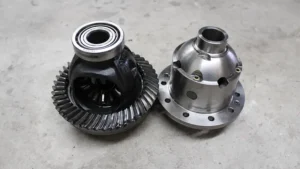
For drivers who need better traction on uneven terrain, a differential locker or limited slip differential can be an important drivetrain upgrade.
At XJXPARTS, we specialize in manufacturing aftermarket drivetrain components for 4WD vehicles.
We work with wholesale distributors, 4WD workshops, automotive parts dealers, and OEM customers worldwide.
Send us your chassis code, production year, front or rear axle information, and differential photos. Our technical team can help check compatibility and identify a suitable product for your vehicle.