Note: XJXParts is not related to any product or model code such as ‘xjx-400’, ‘xjx-212’, or other similar terms. Our focus is exclusively on differential and drivetrain technology.

How Does a Limited Slip Differential Work

If you have ever watched one wheel spin helplessly while the other sits still, you have already seen the limitation that a limited slip differential (LSD) was designed to solve.
An LSD is one of the most effective drivetrain upgrades available — not because it is complicated, but because it solves a real problem in a mechanically elegant way. This guide explains how it works, walks through the three main types, and helps you understand which one fits your application.
how-does-a-limited-slip-differential-work

Why an Open Differential Falls Short

Before understanding an LSD, it helps to understand what it replaces.
A standard open differential allows each driven wheel to rotate at a different speed. This is necessary for cornering — the outside wheel travels a longer arc than the inside wheel, so it must spin faster. An open differential handles this perfectly under normal conditions.
The problem emerges when one wheel loses traction. Because an open differential always sends torque to the path of least resistance, a wheel sitting on ice, mud, or in the air receives almost all the available torque — and spins uselessly. The wheel with grip gets almost nothing. The vehicle stops moving.
This is the fundamental weakness a limited slip differential addresses.

Why an Open Differential Falls Short

A limited slip differential allows the two output shafts to rotate at different speeds (like an open differential) but limits how much speed difference is permitted before it intervenes. When one wheel begins to slip significantly faster than the other, the LSD applies an internal resistance force that redirects torque toward the slower-spinning, higher-traction wheel.
The result: both wheels contribute to forward motion, even when traction is unequal between them.
The key word is limited — an LSD does not lock the axle completely. It allows some speed differentiation for normal cornering, but prevents the extreme wheel speed differences that cause one wheel to spin freely while the other stalls.

The Three Main Types of LSD

There are three fundamentally different mechanisms used to achieve this torque redistribution. Each has distinct characteristics, and each suits a different application.

1. Clutch-Type LSD

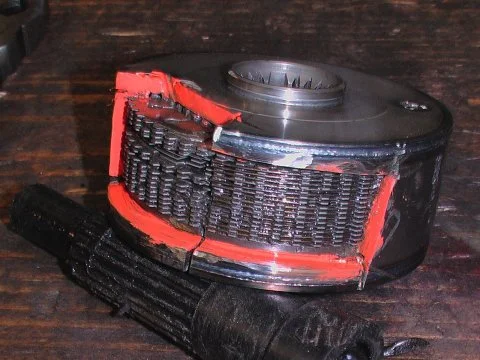
The clutch-type LSD is the most widely used design. Inside the differential housing, a stack of friction clutch plates is preloaded by springs against the side gears. When a speed difference develops between the two axles, these clutch plates create friction that resists the difference and transfers torque to the slower wheel.
The behavior of a clutch LSD can be tuned by adjusting the preload (spring pressure) and the number of clutch plates — making it highly configurable for street driving, track use, or off-road applications.
Characteristics:
  • Strong torque transfer, especially under acceleration
  • Tunable bias ratio
  • Requires periodic maintenance (fluid changes, eventual plate replacement)
  • Can produce slight chatter noise during low-speed cornering if the fluid is due for a change
  • Well-suited to performance driving, track use, and aggressive off-road applications
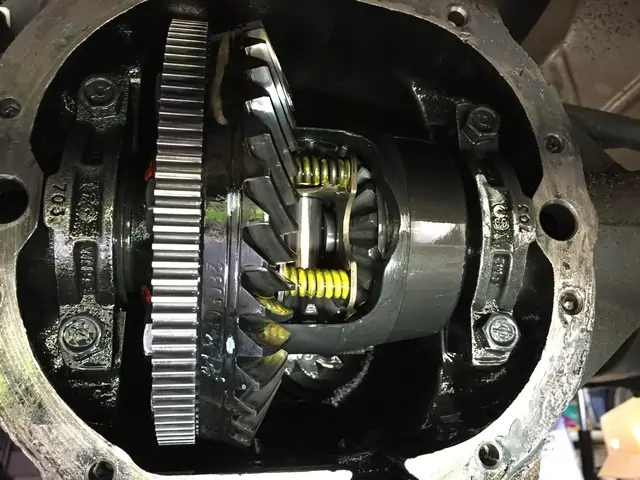
clutch type limited slip differential

2. Helical Gear LSD (Torsen / ATB Type)

The helical gear LSD — commonly known by the brand name Torsen, or as an Automatic Torque Biasing (ATB) differential — uses a set of worm or helical gears instead of friction plates to generate resistance.
When a speed difference develops between the two axles, the gear geometry itself creates internal resistance forces that bias torque toward the gripping wheel. The response is continuous, progressive, and entirely passive — no clutches, no wear components, no fluid additives required.
The maximum torque split is defined by the Torque Bias Ratio (TBR), which is determined at the design stage by the gear geometry. A TBR of 4:1, for example, means up to four times more torque can be directed to the gripping wheel.
Characteristics:
  • Smooth, progressive torque distribution
  • No maintenance wear components
  • Instantaneous mechanical response
  • Cannot transfer torque when one wheel has zero traction (full wheel lift)
  • Ideal for street driving, performance road use, and AWD center differentials
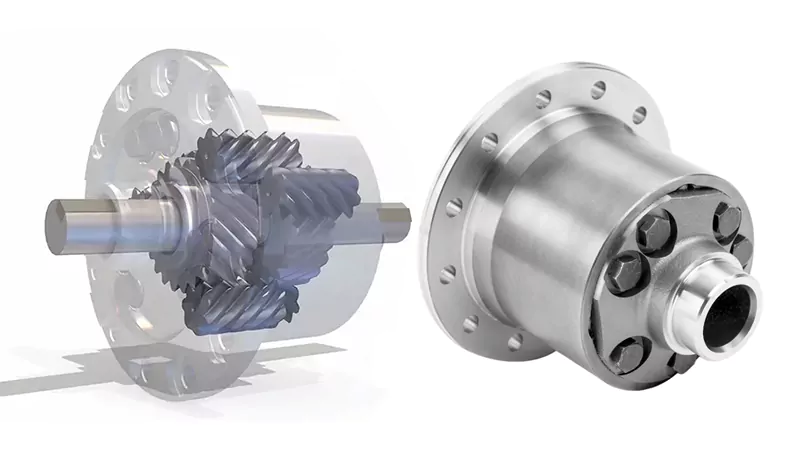
Torsen differential

3. Viscous LSD

A viscous LSD uses a sealed chamber filled with a thick silicone fluid. Alternating discs — some connected to one output shaft, some to the other — are submerged in this fluid. Under normal driving, the discs rotate together and no significant force is generated.
When a speed difference develops, the viscous fluid between the discs shears and thickens, creating resistance that transfers torque to the slower wheel. The response is proportional to the speed difference and builds gradually.
Characteristics:
  • Very smooth, progressive engagement
  • No driver input or maintenance required
  • Slower response compared to clutch or helical types
  • Commonly used in AWD systems and as a center differential
  • Not serviceable when worn — typically requires full replacement
Open Differential vs Limited Slip: A Direct Comparison

Open Differential Limited Slip Differential
Allows different wheel speeds
Yes
Yes (within limits)
Transfers torque to gripping wheel
No
Yes
Works when one wheel lifts
No
Partially (type-dependent)
Maintenance required
Minimal
Low to moderate
Suitable for performance use
No
Yes
Suitable for off-road use
Limited
Yes
The open differential remains perfectly adequate for everyday driving on paved roads where traction is consistent. The moment conditions become unequal — rain, gravel, a performance corner, a slippery incline — the LSD demonstrates its advantage.

How an LSD Improves Traction: Real-World Scenarios

Wet or icy roads: On a slippery surface, an open differential allows the low-traction wheel to spin while the vehicle stalls. An LSD senses the speed difference and redirects torque to the wheel with grip, allowing the vehicle to accelerate through conditions that would otherwise leave it stuck.
Cornering under power: When accelerating out of a corner, weight transfers to the outside wheels, reducing traction on the inside. An LSD transfers additional torque to the outside (higher-traction) wheel, reducing understeer and helping the vehicle rotate cleanly through the corner.
Off-road terrain: On uneven ground, one wheel can lose contact with the surface entirely. An open differential sends all available torque to the airborne wheel — achieving nothing. An LSD limits this behavior by redistributing torque to the wheel that still has ground contact. Note: for extreme off-road use where full wheel lift is common, a locking differential provides more complete traction recovery than any LSD type.

Performance launches: Under hard acceleration from a standing start, torque tends to overpower the inside rear wheel on a rear-wheel drive car. An LSD distributes torque more evenly, reducing wheel spin and improving launch traction.

Which LSD Type Is Right for Your Application?

Application Recommended Type
Daily street driving
Helical / Torsen LSD
Performance road driving
Clutch LSD or Helical LSD
Track / motorsport
Clutch-type LSD (tunable)
Drifting
Clutch-type LSD (high preload)
Light off-road
Helical LSD or Clutch LSD
Extreme off-road
Locking differential (not LSD)
AWD center differential
Viscous or Helical LSD
Fleet / commercial vehicle
Helical LSD (low maintenance)

For fleet operators and B2B buyers, the helical LSD’s absence of wear components and minimal maintenance requirements make it the most cost-effective long-term solution for high-mileage applications.

LSD vs Locking Differential: Know the Difference

An LSD and a locking differential are often confused, but they serve different purposes.
An LSD limits slip — it allows some speed difference between wheels but prevents excessive spin-out. It is designed to remain active during normal driving without affecting handling.
A locking differential eliminates speed difference entirely, forcing both wheels to rotate at exactly the same speed. This maximizes traction in extreme conditions but makes the vehicle difficult to steer on paved surfaces and must be disengaged for normal driving.

For most on-road and mixed-use applications, an LSD is the more practical choice. For dedicated off-road or rock-crawling use, a locker delivers traction that no LSD can match.

Frequently Asked Questions

Does an LSD require special gear oil?
Clutch-type LSDs require gear oil with a friction modifier additive to prevent clutch chatter. Helical and viscous LSDs typically use standard differential fluid without additives. Always check the manufacturer specification for your specific unit.

How long does an LSD last?
A helical (Torsen-type) LSD has no wear components and can last the lifetime of the vehicle. A clutch-type LSD requires fluid changes every 30,000–50,000 km and clutch plate replacement every 80,000–150,000 km depending on use intensity.

Can I retrofit an LSD into a vehicle that came with an open differential?
In most cases, yes. A replacement LSD that fits the same differential housing and uses the same ring gear can be installed as a direct replacement. XJX supplies OE-compatible and custom LSD units for a wide range of vehicle platforms.

Does an LSD work in all driving conditions?
An LSD improves traction in most conditions where one wheel has less grip than the other. The one exception is when a wheel has zero traction — for example, fully in the air. In this case, helical LSDs provide no torque transfer. Clutch-type LSDs provide limited transfer depending on preload. Only a locking differential fully addresses this scenario.

Summary

A limited slip differential solves the core weakness of an open differential by redirecting torque toward the wheel with better grip whenever a speed difference develops between the two axles. The three main mechanisms — clutch plates, helical gears, and viscous fluid — achieve this in different ways, each with its own trade-offs in terms of response, maintenance, and tunability.

For the majority of street and performance applications, an LSD delivers a meaningful improvement in traction, handling, and driving confidence with no compromise to everyday usability. 

If you are looking for a reliable LSD solution for your application, feel free to contact XJX Parts. We support a wide range of vehicle platforms and can provide technical guidance, specifications, and bulk supply options tailored to your market needs.
Don’t Stop Here

More To Explore

download catalog now!