But when I look back at the entire Jeep evolution, I notice one thing:
From the Willys MB that crossed battlefields, to the Wrangler JL climbing rocks today, every generation was created for people who want to explore beyond normal roads
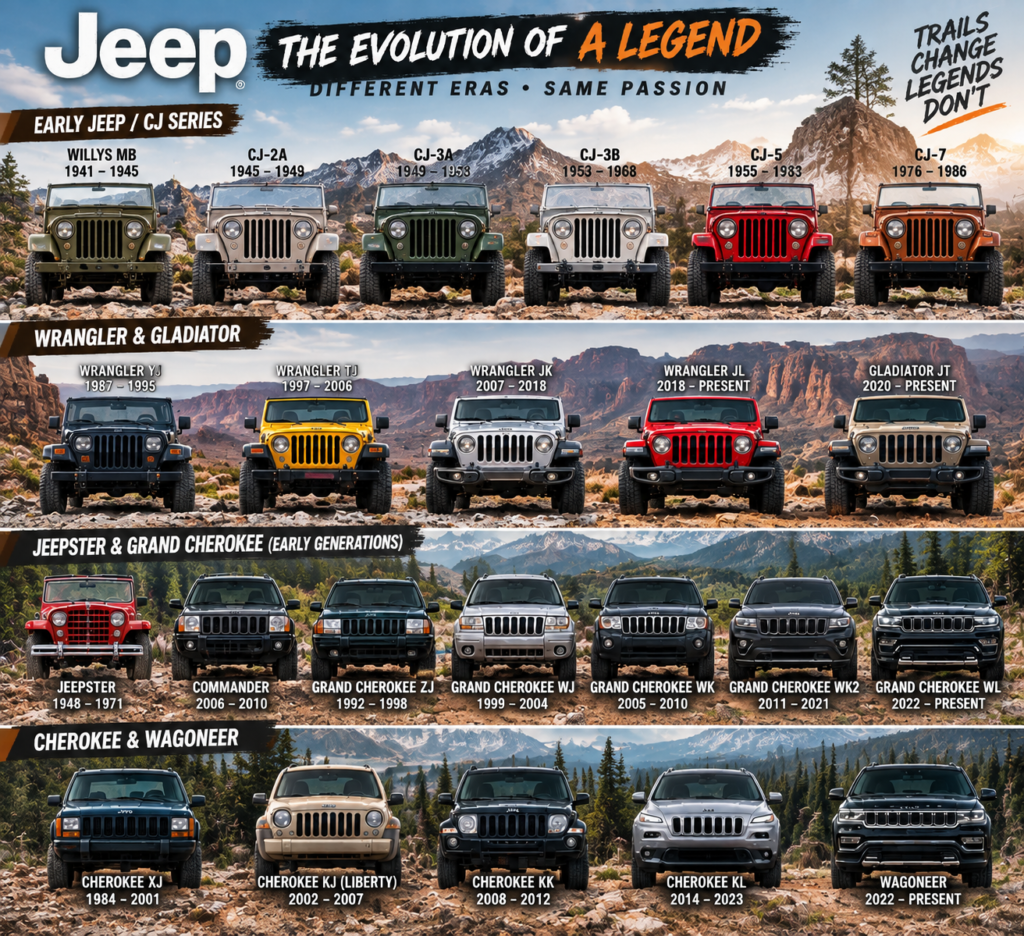
From Military Vehicle to Adventure Icon
Most people know Jeep as an off-road vehicle, but few remember that its story started with a military mission.
The Willys MB was not designed to be comfortable.
It was not designed to be beautiful.
It was designed to survive.
During World War II, this small 4×4 vehicle proved that a lightweight machine could go through places where traditional vehicles would fail.
Mud, rocks, mountains, and difficult terrain were exactly where the Willys MB showed its strength.
What impressed people most was not its power, but its reliability.
A simple mechanical structure meant fewer problems and easier repairs.
That idea became the foundation of Jeep:CJ Series: When Jeep Became More Than a Military Vehicle
After the war, many people did not want to say goodbye to this capable machine.
That is when Jeep began creating civilian models.
The CJ series brought Jeep from the battlefield into everyday life.
The CJ-2A, CJ-3A, and CJ-3B became popular among farmers, workers, and outdoor enthusiasts because they could handle almost anything.
Then came the CJ-5.
For many Jeep fans, the CJ-5 represents the classic Jeep spirit.
It was simple.
It was durable.
And most importantly, it was easy to modify.
Even today, many classic Jeep owners continue upgrading their CJ models because the basic design still works.
The CJ-7 pushed Jeep even further toward the future.
With a longer body and improved comfort, it showed that a vehicle could be both practical and fun.
Wrangler YJ: The Beginning of Modern Jeep Culture
When Jeep introduced the Wrangler YJ in 1987, the world of Jeep changed.
The YJ was no longer just a utility vehicle.
It became a lifestyle vehicle.
Yes, people still debate about the square headlights.
Some Jeep fans loved them.
Some did not.
But nobody can deny that the YJ opened Jeep to a new generation of owners.
It offered better road comfort while keeping the ability to leave the pavement behind.
This balance became one of Jeep’s biggest advantages.
Wrangler TJ: The Generation Many Enthusiasts Still Love
If you spend time talking with Jeep enthusiasts, the Wrangler TJ will almost always come up.
The reason is simple:
The TJ feels like the perfect combination of old-school Jeep and modern engineering.
The biggest change was the coil spring suspension.
For off-road driving, suspension movement is everything.
When one wheel climbs over a rock and another drops into a hole, the vehicle needs articulation to keep tires connected to the ground.
When one wheel climbs over a rock and another drops into a hole, the vehicle needs articulation to keep tires connected to the ground.
That is why the TJ became such a popular platform for:
- Rock crawling
- Trail driving
- Overlanding builds
Many owners started upgrading their TJ with:
- Larger tires
- Suspension kits
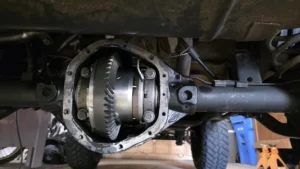
- Differential lockers
- Lower gear ratios
because they wanted to go further than the factory setup allowed.
Wrangler JK: The Generation That Changed Jeep Modification
When it was released in 2007, it became one of the most popular off-road platforms in the world.
Why?
Because it gave owners more possibilities.
The JK had:
- More interior space
- Stronger drivetrain options
- Better comfort
- Huge aftermarket support
It became the foundation for thousands of custom builds.
But there was also a challenge.
Many owners started installing larger tires.
A stock Jeep with 32-inch tires is one thing.
A modified Jeep running 35-inch or 37-inch tires is completely different.
The larger the tire, the more stress goes into the drivetrain.
That is when many owners begin looking at:
- Ring and pinion upgrades
- Differential lockers
- Stronger differential components
Because having horsepower is meaningless if the power cannot reach the wheels.
Wrangler JL: Modern Technology, Same Jeep Spirit
The Wrangler JL represents how Jeep has adapted to modern drivers.
Today’s Jeep owners want both worlds:
They want advanced technology.
They want comfort.
But they also want real off-road capability.
The JL improved many areas:
- Weight control
- Interior design
- Engine efficiency
- Electronics
However, when the vehicle enters difficult terrain, the same basic challenge remains:
Traction.
A powerful engine does not help when one tire is spinning in the air.
That is why many serious JL owners still upgrade their differential systems.
Gladiator JT: Jeep Creates a New Way to Explore
When Jeep launched the Gladiator, many people saw it as something completely new.
It combined the Wrangler’s off-road ability with pickup truck practicality.
For people who travel with:
- Camping equipment
- Tools
- Recovery gear
- Adventure equipment
the Gladiator offers something the Wrangler cannot.
It is not replacing Wrangler.
It is expanding the Jeep lifestyle.
Cherokee and Grand Cherokee
Not every Jeep owner spends every weekend climbing rocks.
Some people want adventure during holidays but need comfort every day.
That is where Cherokee and Grand Cherokee changed Jeep’s direction.
The Cherokee XJ became a legend because it was compact, lightweight, and extremely capable.
Many XJ owners still build impressive off-road vehicles today.
The Grand Cherokee took another path.
It showed that a Jeep could be:
- Comfortable on highways
- Practical for families
- Capable off-road
Generations like ZJ, WJ, WK, WK2, and WL continued improving this balance.
Why Differential Upgrades Become Important for Jeep Owners
After working with drivetrain components for many years, one thing is clear:
Many Jeep owners do not upgrade parts because they want a different vehicle.
They upgrade because they want their Jeep to perform better in the situations they actually enjoy.
A stock differential works well for normal driving.
But serious off-road conditions are different.
Imagine:
- One wheel is completely off the ground.
- One tire is stuck in mud.
- One side is on slippery rocks.
This is where a better differential system makes a difference.
Final Thought
From the Willys MB to the Wrangler JL, every Jeep generation tells a different story.
Some were built for war.
Some were built for work.
Some were built for family.
Some were built for extreme adventure.
But all of them share the same idea:
The road is only the beginning.
That is why Jeep remains one of the most respected names in the off-road world.
Because Jeep is not just about getting somewhere.
It is about how you get there.