Air lockers are widely used in 4×4 and off-road applications because they allow the driver to switch between normal differential operation and a fully locked differential when additional traction is required.
While the basic operating principle remains similar, advances in internal design can significantly change the sealing system, locking engagement and overall mechanical design. The new No-O-Ring Air Locker introduces two key structural changes: a redesigned sealing system without the traditional O-ring and a deeper 5 mm locking engagement depth.
Working Principle
Both traditional O-ring air lockers and the new No-O-ring air locker use compressed air to activate the locking mechanism.
When the locker is disengaged, the differential operates normally, allowing the left and right wheels to rotate at different speeds.
When air pressure is applied, the actuator moves the locking mechanism and engages the clutch gear with the side gear. This mechanically couples the two sides of the differential, providing a locked differential for improved traction.
When air pressure is applied, the actuator moves the locking mechanism and engages the clutch gear with the side gear. This mechanically couples the two sides of the differential, providing a locked differential for improved traction.
Both designs use core differential components such as:
- Side Gears
- Spider/Pinion Gears
- Cross Shafts
- Differential Case
- Clutch Gear
- Thrust Components
- Air Actuation System
Therefore, the major difference is not the basic function of an air locker, but how the sealing and locking mechanisms are designed.
Traditional Air Locker: O-Ring Sealing Design
Traditional air lockers commonly use an O-ring-based sealing system around the air-actuation area.
The O-ring provides the seal required to maintain air pressure while the differential and related components operate.
This design has been widely used because of its relatively straightforward sealing principle. However, O-rings are wear components and their sealing performance can be affected by factors such as:
- Wear over time
- Improper installation
- Contamination
- Damage during assembly
- Temperature and operating conditions
- Aging of the sealing material
For an air-operated locking system, maintaining effective air sealing is essential because insufficient air pressure can affect locker engagement.
No-O-Ring Air Locker: Redesigned Sealing System
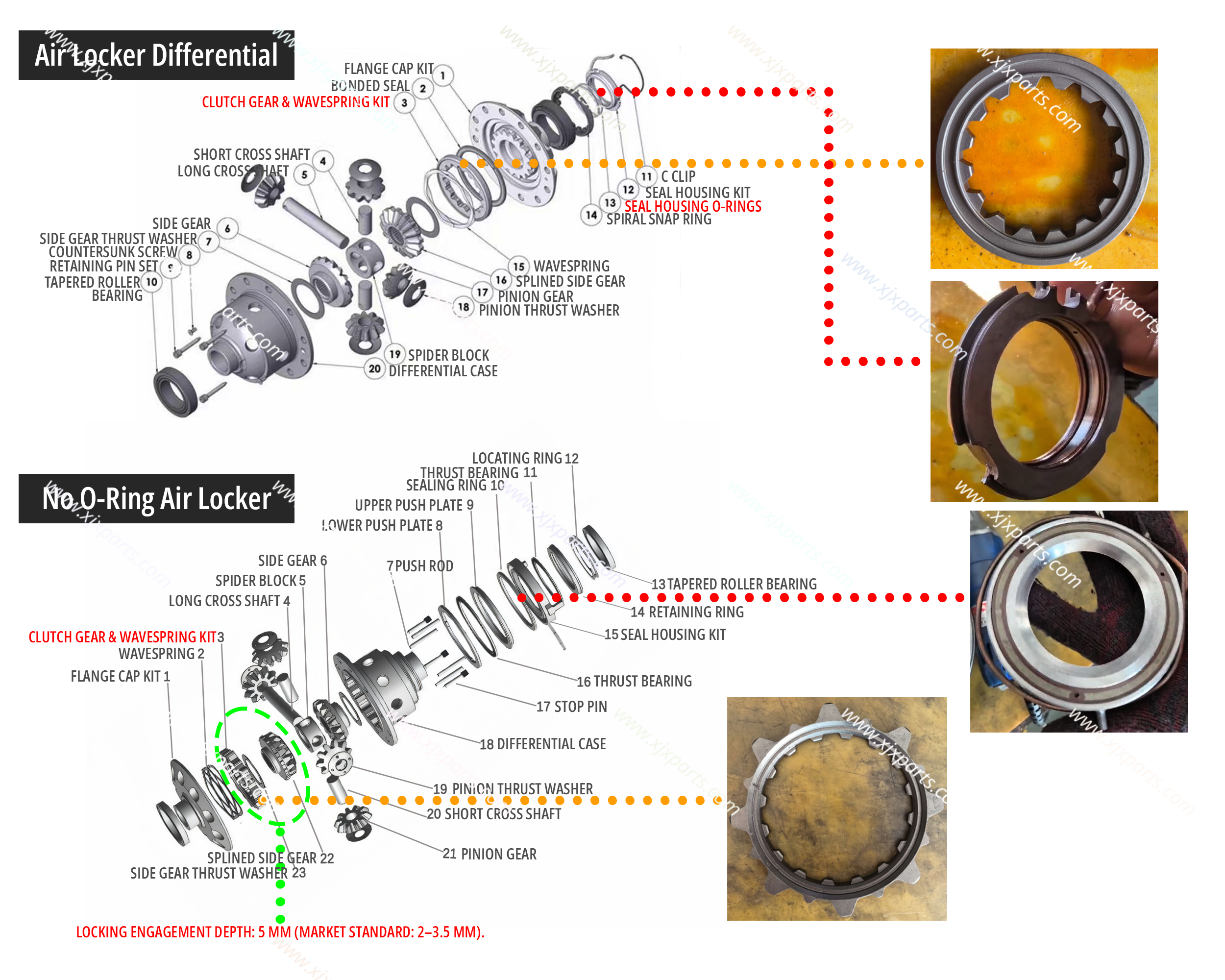
The new air locker adopts a No-O-Ring sealing design.
Instead of relying on the traditional O-ring arrangement, the sealing and support structure has been redesigned.
This means the No-O-Ring design is not simply an O-ring being removed. It represents a different sealing and support structure around the actuator system.
Key concept
Traditional Air Locker
O-Ring + Conventional Seal Housing
No O-Ring Air Locker
No O-Ring + Redesigned Sealing & Support Structure
This design aims to reduce dependence on the traditional O-ring sealing arrangement while maintaining the required sealing and operating performance.
Deeper Locking Engagement: 5 mm
Another important difference is the locking engagement structure.
The new air locker features a 5 mm locking engagement depth between the locking components.
The comparison diagram indicates a typical market reference range of approximately 2–3.5 mm.
A deeper engagement means that more of the mating tooth surfaces can participate in the locking connection when the locker is fully engaged.
This can provide:
- Deeper gear engagement
- Greater effective contact area
- Better load distribution across the engaged teeth
- A more substantial mechanical connection
- Increased design margin for demanding off-road applications
Importantly, 5 mm engagement depth should not be interpreted as a direct 80% increase in overall differential strength. Engagement depth is only one factor affecting load capacity; tooth geometry, material, heat treatment, tooth width, clearances and the complete differential structure also contribute.