Both E-Lockers and Air Lockers Do the Same Basic Job
An open differential allows the left and right wheels to rotate at different speeds. That is excellent for normal road driving.
The problem appears when one wheel loses traction.
On rocks, mud, sand, deep ruts or cross-axle terrain, one wheel may spin while the other wheel receives very little usable torque.
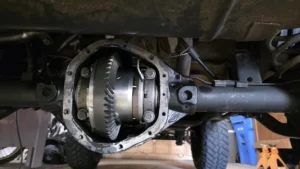
A selectable differential locker solves that problem by locking both axle shafts together.
Once engaged, both wheels are driven together.
That is why both an elec differential locker and an air differential locker can dramatically improve off-road traction.
From the driver’s point of view, both systems are trying to achieve the same result:Why Many Off-Road Drivers Like Air Lockers?
When the pneumatic system is working correctly, engagement is fast and positive. For experienced off-road drivers, especially people who have used Air Lockers for many years, that familiarity creates confidence.
In difficult terrain, confidence matters.
When a vehicle is balanced on rocks with one wheel in the air, the driver does not want to wonder what is happening inside the differential.
He wants to press the switch and know the axle is locked.
That is one of the strongest advantages of a good Air Locker.
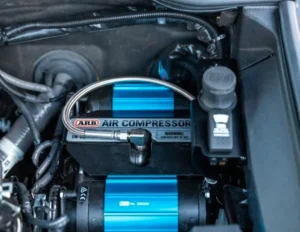
Another benefit is that the compressor may also be used for tyre inflation, depending on the system.
For some off-road builds, the compressor is already part of the vehicle anyway.
In that case, adding an Air Locker feels completely natural.What is The Real Concern With Air Lockers?
The problem may come from:
- the external air line;
- a fitting;
- a solenoid;
- an O-ring or seal;
- the internal air tube;
- compressor pressure;
- incorrect installation.
You have the locker itself, air seals, air lines, fittings, solenoid valves, wiring and a compressor.
Every additional component gives the installer one more thing that must be fitted correctly.
That does not mean Air Lockers are unreliable.
A properly installed Air Locker can work for years without trouble.
But the system is more complex, and complexity means there are more places to check when something stops working.
That is one reason some off-road drivers eventually move toward E-Lockers.Why E-Lockers Have Become So Popular?
There is no compressor.
There is no pneumatic hose running from the engine bay to the axle.
There is no air pressure to maintain.
There are no pneumatic fittings to troubleshoot.
The basic system is:
switch → wiring → electrical actuator or electromagnetic locking mechanism → differential locker.
For many vehicle owners, that is very attractive.
This is especially true for daily-driven 4x4s.A Land Cruiser, Hilux, Tacoma, Jimny or Jeep may spend 90% of its life on normal roads and only occasionally enter difficult terrain.
For that type of vehicle, many owners simply want a selectable locker that stays invisible during normal driving and works when the trail becomes difficult.
That is where an E-Locker makes a lot of sense.But “Simpler” Does Not Automatically Mean “Better”
That is only half the story.
An E-Locker has its own critical components.
The electrical actuator, locking collar, pins, cam mechanism or electromagnetic system must engage correctly.
The wiring must be protected.
The actuator must survive water, mud, vibration and heat.
Most importantly, the locking mechanism must remain reliable when the vehicle is under load.
For a serious off-road driver, this matters much more than how clean the wiring diagram looks.
A locker that works perfectly on a workshop lift but struggles to engage on a steep rock climb is not a good locker.
That is why I think E-Locker reliability should be evaluated under real driving conditions, not only on a bench.Engagement Is One of the Most Important Differences
Not all E-Lockers use the same internal design.
This is important.
Some electric lockers use an external motor and sliding collar.
Others use an electromagnetic system with a locking or cam mechanism.
Because the designs are different, engagement behaviour can also be different.
Some designs may need slight wheel movement before the locking teeth fully align.
Some may react differently when changing from forward to reverse.
For normal off-road driving, this may not matter much.
But in technical rock crawling, even a small delay can matter.
Imagine the vehicle is sitting against a rock.
You have only a few centimetres to move.
You select the locker.
At that moment, you want to know exactly how the differential will behave.At that moment, you want to know exactly how the differential will behave.
That is why, when comparing an E-Locker vs Air Locker, I would not only ask:
“Does it lock?”
I would ask:
How quickly does it lock?
Does it stay locked when changing direction?
How does it behave under torque?
How much wheel rotation is needed for full engagement?
Those are much better questions.Which Is Better: E-Locker or Air Locker?
I do not think there is one answer for every driver.
If I were building a dedicated rock crawler and I already had an onboard air system, a proven Air Locker would still be a very strong choice.
If I wanted the simplest selectable locker system for a daily-driven 4×4, expedition vehicle or weekend off-road build, I would seriously consider an E-Locker.
For many drivers, the E-Locker wins because of simplicity.
No compressor.
No air line.
No pneumatic sealing system.
Fewer external components.
For other drivers, the Air Locker wins because they trust its engagement characteristics and long history in serious off-road use.
Neither decision is unreasonable.What I Would Look at Before Buying Any Differential Locker?
Forget the logo on the box for a moment.
Before choosing an off-road locker, I would look at five things.
- First, how the locker engages.
- Second, how strong the internal locking components are.
- Third, how well the actuator or pneumatic system is protected.
- Fourth, whether spare parts and technical support are available.
- And finally, whether the locker has actually been tested in conditions similar to the way I intend to use the vehicle.
Those factors matter much more than whether the locker is activated by air or electricity.
Final Thoughts
The E-Locker vs Air Locker argument will probably continue for a long time.
That is normal.
Off-road drivers have different vehicles, different terrain and different expectations.
But after spending years around differential products, one thing has become very clear to me:
A good locker is not just a locker that can reach 100% lock.
A good locker needs to engage when the driver asks for it.
It needs to stay locked under load.
It needs to survive repeated shock.
And the complete system needs to be reliable enough that the driver trusts it when one wheel is hanging in the air and the only way forward is up.
That is what really matters.
Whether that system uses electricity or compressed air comes second.