If you’ve ever driven a 4×4 truck on snow, mud, or rocky trails, you’ve probably experienced this situation: one wheel starts spinning, but the truck barely moves.
It’s frustrating, especially when the other wheel still has plenty of grip.
So why does this happen? And would a helical limited slip differential (LSD) or a locking differential make a difference?
To understand that, let’s look at how these two types of differentials work and what happens when the terrain gets challenging.
How Does a Helical LSD Work?
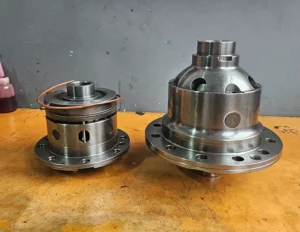
A helical LSD is designed to help transfer more driving torque to the wheel with better traction. It uses a set of specially designed helical gears inside the differential to create resistance and bias torque between the two wheels.
Unlike a traditional clutch-type limited slip differential, a typical helical LSD doesn’t rely on friction clutch plates to control wheel slip. It works mechanically through the interaction of its internal gears.
One of the things I like about this design is how naturally it works. There’s no need for the driver to switch it on when a wheel starts slipping. The differential responds automatically to changes in resistance between the two wheels.
On gravel roads, snowy surfaces, and many everyday off-road trails, this can make a real difference. Instead of allowing one wheel to spin freely while the other does very little, the helical LSD helps the wheel with better grip receive more torque.
But there’s something important to understand: a helical LSD doesn’t have unlimited torque-biasing capability.
And that’s where things get interesting.
What Happens When One Wheel Is on Ice?
Imagine you’re driving a 4×4 truck with one rear wheel on ice and the other on a surface with much better grip.
You press the accelerator. The wheel on the ice starts spinning, but the truck doesn’t move as expected.
You might wonder why the differential isn’t sending more power to the wheel that actually has traction.
The answer comes down to how a helical LSD works.
A helical LSD needs some reaction torque at the low-traction wheel to bias more torque toward the opposite wheel. When that wheel has almost no resistance, the differential may not be able to deliver enough torque to the wheel with better grip.
For example, a differential with a 3:1 torque bias ratio can theoretically deliver three times as much torque to the higher-traction side as to the lower-traction side under suitable conditions. But if the low-traction wheel can support very little torque, the available torque on the other side may still be too low to get the vehicle moving.
This doesn’t mean a helical LSD is ineffective in snow, mud, or sand. It means its performance depends on the traction available at both wheels and the amount of torque the differential can bias.
There’s a big difference between a wheel that has limited grip and one that’s almost completely unloaded.
Why Does a Locking Differential Make a Difference?
Now let’s try the same situation with a locking differential.
With the differential unlocked, the wheels can rotate at different speeds, and the helical LSD works to bias torque between them. When the differential is fully locked, however, the left and right axle shafts are mechanically coupled.
Both wheels must rotate at the same speed, assuming the locking mechanism and drivetrain remain intact.
That changes the situation significantly.
Even if one wheel is on ice, the wheel on the higher-traction surface can help push the truck forward because the axle is no longer relying on the helical LSD’s torque-biasing capability alone.
This is why a locking differential can be so useful when driving over rocks, through deep ruts, or across uneven terrain where one wheel may have very little contact with the ground.
Of course, a locker doesn’t magically create grip. If neither tire has traction, locking the differential won’t solve that problem. What it does is allow the drivetrain to make better use of the traction that is available.
That’s the key difference.
Is a Locking Differential Always Better Than a Helical LSD?
Not necessarily. It really depends on how you use your vehicle.
If your truck spends most of its time on the road and occasionally ventures onto gravel tracks, snowy roads, or moderate off-road trails, a helical LSD can be an excellent choice.
It works automatically, provides smooth torque transfer, and allows the wheels to rotate at different speeds when cornering. For many drivers, that’s exactly what they need.
But if you regularly tackle serious off-road terrain, the situation changes.
Rock crawling, deep mud, uneven trails, and situations where one wheel is lifted off the ground can expose the limitations of a helical LSD. In these conditions, having the ability to lock the differential can give you a significant advantage.
A selectable locking differential, or E-Locker, offers a practical solution. You can leave it unlocked during normal driving and engage the lock when the terrain demands more traction.
That flexibility is particularly useful for 4×4 pickups and SUVs that need to handle both daily driving and demanding off-road conditions.
One thing to remember: a selectable locker should generally be disengaged on high-grip paved roads, especially when making tight turns, because the wheels need to rotate at different speeds when cornering.
Looking for the Right Differential for Your 4x4?
At XJXPARTS, we manufacture helical limited slip differentials and elec selectable locking differentials for a range of 4×4 applications.
We work with distributors, automotive parts dealers, and off-road workshops looking for reliable differential solutions, OEM supply, and wholesale cooperation.
If you’re sourcing helical LSDs or E-Lockers for your market, get in touch with our team to discuss your vehicle applications and fitment requirements.