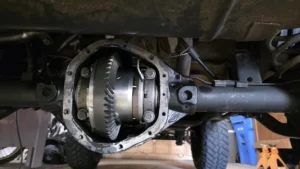
Ring and pinion gears are among the most critical components inside a vehicle’s differential. They transfer power from the driveshaft to the wheels while also reducing rotational speed and increasing torque.
Because these gears operate under extreme load, friction, and continuous contact, the material used in manufacturing plays a significant role in their performance and service life.
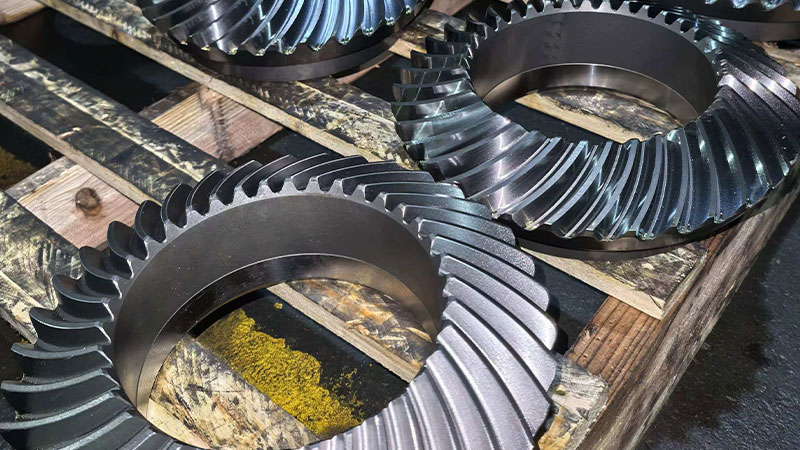
In this article, we will explore why ring and pinion gear material matters, the most common steels used in differential gear production, and how material selection influences gear durability.
Why Ring and Pinion Gear Material Matters?
A ring and pinion gear set operates under harsh mechanical conditions. During acceleration, towing, or off-road driving, these gears must withstand:
- High torque loads
- Continuous sliding contact between gear teeth
- Impact forces during sudden load changes
- Long-term fatigue stress
If the gear material is not suitable for these conditions, problems such as premature wear, gear noise, pitting, or tooth breakage may occur.
For this reason, differential gears are typically manufactured using carburizing alloy steels, which provide a combination of:
- Hard wear-resistant surfaces
- Tough internal core strength
- High fatigue resistance
Common Materials Used for Ring and Pinion Gears
Several types of alloy steel are widely used in automotive differential gears. Among them, 20CrMnTi and SAE 8620 are two of the most common materials.
20CrMnTi Carburizing Steel
20CrMnTi is a low-alloy carburizing steel widely used in automotive gear manufacturing, particularly in Asia.
This steel contains chromium, manganese, and titanium, which help improve strength and heat treatment stability. After carburizing and quenching, it can achieve high surface hardness while maintaining a tough core.
Key advantages of 20CrMnTi include:
- Excellent wear resistance
- Stable heat treatment performance
- Good fatigue strength
- Cost-effective for large-scale gear production
Because of these properties, 20CrMnTi is commonly used for:
Differential gears, Transmission gears, Automotive drive components. Many OEM automotive gears are manufactured using this material.
SAE 8620 Alloy Steel
SAE 8620 is another widely used carburizing steel, especially in North America and Europe.
Unlike 20CrMnTi, 8620 contains nickel, chromium, and molybdenum, which improve toughness and impact resistance.
After carburizing heat treatment, 8620 steel provides:
- Hard gear tooth surfaces
- Strong internal toughness
- Excellent fatigue resistance
Because of its toughness, 8620 is often used in applications where gears experience higher shock loads, such as:
- Off-road vehicles
- Performance vehicles
- Heavy-duty drivetrain components
20CrMnTi vs 8620: What Is the Difference?
Both materials belong to the category of carburizing gear steels, but their alloy compositions differ.
20CrMnTi relies on chromium, manganese, and titanium to improve strength and grain stability, while 8620 uses nickel and molybdenum to enhance toughness and fatigue resistance.
In practice, both materials can achieve similar surface hardness after carburizing. The main difference lies in toughness and cost.
20CrMnTi is widely used in large-scale automotive production due to its cost efficiency and stable performance, while 8620 is often preferred in markets that follow American material standards.
Other Factors That Affect Ring and Pinion Gear Lifespan
Although material selection is important, it is not the only factor that determines gear durability. In fact, several manufacturing processes have an even greater influence on the lifespan of differential gears.
Heat Treatment
Proper carburizing and quenching processes are critical. High-quality ring and pinion gears typically have:
- Surface hardness of 58–62 HRC
- Carburized case depth of 1.0–1.5 mm
This structure provides a hard wear-resistant surface and a tough internal core.
Gear Machining Precision
Precision gear cutting and grinding ensure proper tooth contact. Poor machining accuracy can cause:
- Excessive gear noise
- Uneven tooth wear
- Reduced service life
Installation and Gear Setup
Even a well-manufactured ring and pinion gear set can fail prematurely if it is installed incorrectly. Proper backlash, contact pattern, and alignment are essential for long-term durability.
Choosing the Right Material for Ring and Pinion Gears
When selecting a ring and pinion gear set, the choice of material should consider several factors, including:
- Vehicle type
- Torque load
- Driving conditions
- Cost considerations
For most standard automotive applications, 20CrMnTi carburizing steel offers an excellent balance of durability and cost. For applications requiring higher impact resistance, SAE 8620 alloy steel may be preferred.
Ultimately, the best ring and pinion gears combine high-quality material, precise manufacturing, and proper heat treatment.
Conclusion
The material used in ring and pinion gears plays an important role in determining their durability and performance. Both 20CrMnTi and SAE 8620 are proven gear steels widely used in differential gear manufacturing.
However, the true lifespan of a gear set depends not only on the steel itself, but also on heat treatment, machining accuracy, and proper installation.
Understanding these factors can help vehicle owners, mechanics, and gear distributors choose more reliable differential components.
We manufacture ring and pinion gear sets for pickup trucks, light trucks and off-road vehicles, and always enjoy discussing technical topics with professionals in the industry.
I’m curious about your experience:
What material do you normally prefer for ring and pinion gears, and what factors matter most to you — durability, price, or performance?