Note: XJXParts is not related to any product or model code such as ‘xjx-400’, ‘xjx-212’, or other similar terms. Our focus is exclusively on differential and drivetrain technology.

Brake Locking Differential vs. E-Locker: Which Traction Solution Wins?

When navigating off-road terrain or managing slippery road conditions, traction is the currency of progress. For many modern vehicle owners, the term Brake Locking Differential frequently appears in owners’ manuals and marketing brochures. However, as experienced off-roaders and fleet operators know, there is a significant difference between a computer-aided braking system and a dedicated mechanical locker like an E-Locker Differential.

Understanding the Brake Locking Differential
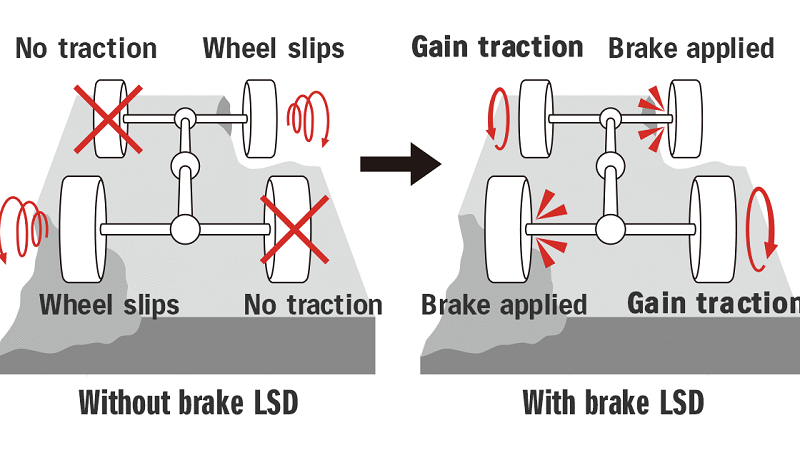
A Brake Locking Differential is not a physical differential in the traditional sense. It is a software-driven feature within a vehicle’s Electronic Stability Control (ESC) and Anti-lock Braking System (ABS).
brake-locking-differential

How Brake Locking Differential Works

In a standard open differential, power follows the path of least resistance. If one wheel is on ice or lifted in the air, that wheel spins freely while the wheel with grip receives zero torque. This is the fundamental weakness of an open diff.

The Brake Locking Differential attempts to “mimic” a limited-slip differential by using the ABS sensors to detect when one wheel is spinning significantly faster than the others. Once detected, the system applies the brake to that specific spinning wheel. By creating artificial resistance on the spinning side, the Brake Locking Differential forces the open differential to transfer torque to the opposite wheel that has traction.

The Limitations of the Brake Locking Differential

While a Brake Locking Differential is a clever use of existing hardware, it has inherent drawbacks:

  • Heat Generation: Constant brake application generates significant heat, which can lead to brake fade during extended off-road sessions.
  • Power Loss: Because the Brake Locking Differential works by applying the brakes, it is essentially fighting the engine. This saps momentum and horsepower.
  • Reaction Time: There is always a delay between wheel spin detection and brake intervention, which can cause you to lose momentum on a steep climb.

What is an E-Locker?
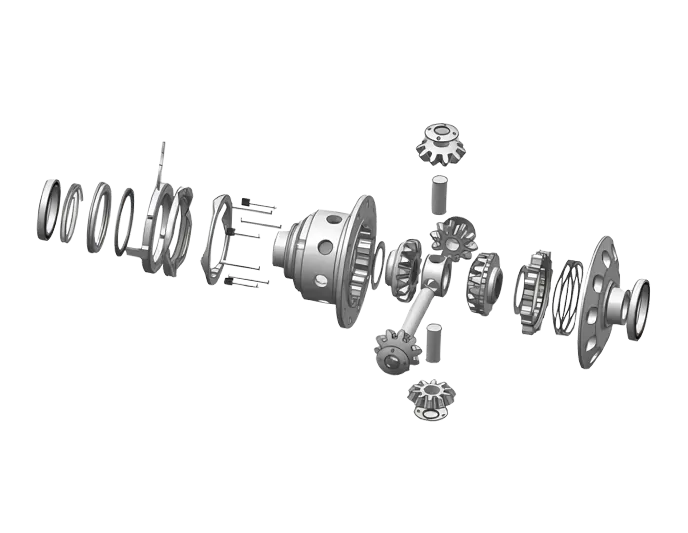
In contrast to the reactive nature of BLD, an E-Locker is a mechanical upgrade installed inside the differential housing. It allows the driver to physically lock the two axle shafts together at the push of a button.
XJX-Electric-Locker-Differential

The Mechanics of Locking

When the E-Locker is engaged, an electromagnet or an electric actuator moves a locking plate or pins to join the side gears to the differential case. This creates a solid connection between the left and right wheels. Regardless of whether one wheel is in the air or buried in mud, both wheels turn at the exact same speed, receiving 100% of the available torque.

Why E-Lockers Are Preferred by Professionals

  • Predictability: You engage the locker before you hit the obstacle. There is no waiting for a computer to “find” traction.
  • Durability: It does not rely on your braking system, preserving your pads and rotors for stopping rather than traction control.
  • Maximum Torque: No power is wasted through braking resistance. All engine output goes directly to the ground.

Brake Locking Differential vs. E-Locker: A Direct Comparison

To truly understand why an E-Locker is often the superior investment for foreign trade operators and off-road enthusiasts, we must look at how they perform in real-world scenarios.
Feature Brake Locking Differential E-Locker (Electronic Locker)
Activation
Automatic (Reactive)
Manual (Proactive)
Component Stress
High stress on brakes/rotors
Low stress (Direct mechanical link)
Torque Delivery
Partial and Intermittent
100% Constant
Off-Road Control
Can feel "jerky" as brakes bite
Smooth, consistent crawling
Maintenance
Increases brake wear
Standard gear oil changes

Performance on Steep Inclines

On a steep, loose-shale incline, momentum is your best friend. A BLD system requires a certain amount of wheel slip to occur before it activates. That split second of slipping can be enough to break the surface tension of the dirt, causing the vehicle to stall or slide.
With an E-Locker, you engage the unit at the base of the hill. As you climb, both wheels dig in simultaneously. There is no “searching” for grip, resulting in a much smoother and safer ascent.

Longevity and Reliability

For those managing commercial fleets or vehicles used in remote areas, reliability is paramount. BLD systems rely on complex electronics, wheel speed sensors, and hydraulic pumps. If a sensor gets caked in mud or a wire is snagged, the system may fail.

An E-Locker is a robust mechanical unit. While it does require a 12V power source to engage, its operation is binary: it is either locked or it isn’t. In the event of an electronic failure, many high-quality units are designed to remain in their last state or default to open, ensuring the vehicle remains drivable.

Why the E-Locker is the Better Investment

If your website focuses on providing high-quality drivetrain components like LSDs (Limited Slip Differentials) or lockers, it is important to emphasize that while BLD is a great “safety net” for the average driver, it is not a performance tool.

1. Superior Traction in "Cross-Axle" Situations

A “cross-axle” situation occurs when the front left and rear right wheels lose contact with the ground. In this scenario, a BLD system is working overtime, pulsing brakes on two corners of the vehicle. This is incredibly taxing on the vehicle’s electrical and hydraulic systems. An E-Locker ignores the lack of contact and simply drives the vehicle forward using the wheels that do have contact.

2. Reduced Tire Wear

It may seem counterintuitive, but E-Lockers can actually reduce tire wear in off-road conditions. Because BLD allows for wheel spin before intervention, the tires are often spinning and “searching,” which can tear up treads on sharp rocks. A locked differential prevents this unnecessary spinning, preserving the life of expensive off-road tires.

3. Driver Confidence

There is a psychological component to off-roading. Knowing that your vehicle is mechanically locked provides a level of confidence that a flickering “Traction Control” light on the dashboard cannot match. For English-speaking customers who value precision engineering and reliability, the E-Locker is the clear choice.

Integrating E-Lockers into Your Vehicle Setup

Many modern trucks and SUVs actually come with BLD from the factory. The good news is that you don’t have to choose one or the other. An E-Locker can be installed to work alongside the factory BLD.
When the E-Locker is off, the BLD handles daily driving and rainy highway conditions. When things get difficult, the driver engages the E-Locker, which effectively “overrides” the need for BLD intervention because no wheel slip will occur. This provides the best of both worlds: computerized safety for the street and mechanical dominance for the trail.

Installation Considerations

Installing an E-Locker requires professional knowledge of gear patterns and backlash settings. It is a “drop-in” replacement for the factory carrier. For international buyers, sourcing these units from a reputable factory ensures that the metallurgy and tolerances meet global standards, which is critical for components handling thousands of pound-feet of torque.

Conclusion

While the Brake Locking Differential is an impressive feat of modern automotive programming, it remains a compromise. It is a system designed by manufacturers to provide “some” off-road capability without adding the cost of mechanical hardware.
However, for those who demand the best—whether for rock crawling, overland expeditions, or heavy-duty commercial use—the E-Locker is the definitive solution. It provides instantaneous, 100% torque transfer without the heat, lag, or wear associated with brake-based systems.
When you are miles away from the nearest paved road, you want a mechanical guarantee, not a software calculation. Investing in a high-quality electronic locking differential is the most significant upgrade you can make to your vehicle’s drivetrain.

As a dedicated manufacturer of high-performance drivetrain components, XJXPARTS specializes in producing robust E-Lockers and LSDs designed for global markets. If you are looking for reliable factory-direct traction solutions, please contact us to discuss your specific needs and bulk ordering options.
Don’t Stop Here

More To Explore

Electronic Differential Lock

What is Electronic Differential Lock?

When you are driving on a rain-slicked highway or navigating a gravel-covered backroad, you rarely think about the complex engineering happening beneath your feet. However,

viscous_lsd

What Is the Limited Slip Differential Meaning

When exploring the world of automotive drivetrains, few components are as critical—yet as frequently misunderstood—as the differential. If you have ever found yourself stuck in

download catalog now!