If you’ve ever been stuck off-road, you know the feeling — one wheel spinning in the air, the other doing nothing. That’s when a locking differential becomes your best friend.
It’s one of those features that can turn a tough trail into a smooth escape. But here’s the thing: it’s not meant for speed.
It’s one of those features that can turn a tough trail into a smooth escape. But here’s the thing: it’s not meant for speed.


When your differential lock is engaged, keep it under 25 mph (about 40 km/h). That’s the golden rule. Diff locks are built for torque and traction — not for highway cruising. At higher speeds, especially on solid ground, the system can’t handle the stress, and your drivetrain might pay the price.
A locked diff forces both wheels on the same axle to spin together, no matter what. Perfect for mud, rocks, or sand — but terrible for tarmac.
How Locking Differentials Work?
A standard differential’s(also known as open differential) job is simple — to let the wheels on the same axle rotate at different speeds.
When you turn a corner, the outer wheel travels a longer distance, so it needs to spin faster than the inner wheel. That difference keeps the vehicle stable and prevents tire wear.
However, in off-road conditions — deep mud, sand, snow, or loose gravel — one wheel often loses traction completely.
In this situation, an open differential sends most of the torque to the wheel that’s slipping, leaving the other wheel powerless. The result: you’re stuck.
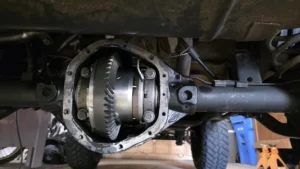
A locking differential solves that problem by forcing both wheels on the same axle to rotate at exactly the same speed, regardless of traction difference. This equal distribution of torque helps your vehicle pull itself out of tough terrain where one wheel alone could never get you moving.
When the diff lock is engaged, your wheels are essentially “mechanically linked.”
This provides unbeatable traction at low speeds, but it also eliminates the differential’s ability to compensate for different wheel paths during turns.
If you try to drive fast with the diff lock on, especially on firm surfaces, here’s what happens:
- Severe drivetrain stress: The axles, driveshafts, and gears are forced to rotate against resistance.
- Excessive tire wear: Since both wheels are turning equally, the tires will scrub and wear unevenly.
- Difficult steering: Cornering becomes stiff and unpredictable because both wheels resist rotation differences.
- Possible mechanical failure: Prolonged use at high speed can damage the differential or locking mechanism.
That’s why most manufacturers (including us) recommend keeping your speed below 25 mph (40 km/h) whenever the differential lock is engaged. This limit is not arbitrary, it’s based on real-world mechanical stress thresholds.
Selectable or Automatic,Which Works for You?
There are two main types of locking differentials:
Selectable (Manual) Lockers
These let the driver decide when to engage or disengage the lock, usually via a switch, lever, or button. They offer full control — ideal for off-road vehicles, performance 4x4s, and commercial equipment that occasionally face tough terrain.
Automatic Lockers
These engage automatically when the system detects a difference in wheel speed.
They’re convenient for some users but can engage abruptly during normal driving, which can surprise the driver and affect handling.
If you prefer not to manually engage the lock every time, an Automatic Locking Differential may be worth considering. These are less common because the driver cannot control when the differential locks. In vehicles equipped with this system, the differential automatically locks based on driving conditions. This can be convenient for some scenarios but may feel limiting or unpredictable on high-traction surfaces.
When to Engage and Disengage the Locker?
Before engaging the diff lock:
- Slow down to a safe speed (ideally under 10 mph).
- Ensure your wheels are pointing straight.
- Engage the lock only in low-traction conditions.
To disengage:
- Drive straight or stop completely.
- Release the lock before entering paved or dry surfaces.
- Wait for the indicator (if equipped) to confirm it’s fully disengaged before accelerating.
Following these steps prevents gear clash and ensures smooth operation of the locking mechanism.
Conclusion
Locking differentials are a powerful mechanical advantage — but only when used correctly. They turn a stuck vehicle into a moving one, but they also demand respect. Keep your speed below 25 mph, engage only when traction is low, and disengage once you’re back on solid ground.
At XJXPARTS, we specialize in Torsen LSDs, differential lockers, designed for performance.
Our engineering team works closely with OEMs, fleet builders, and distributors worldwide to provide durable, precision-built differential solutions for every driving condition.
If your business needs OEM-quality differential systems or custom designs, talk to our team.