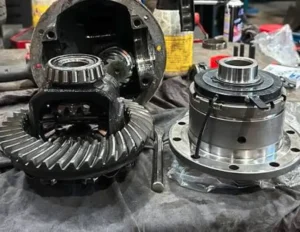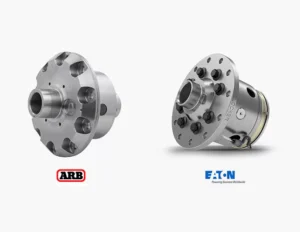
When it comes to vehicle performance, traction, and control, few components are as important as the differential. Whether you are driving on normal roads, pushing a vehicle on a racetrack, or exploring difficult off-road terrain, the differential plays a key role in how power is delivered to the wheels.
You may have seen this situation many times before. A vehicle is trying to move on a slippery road during winter, but one wheel starts spinning wildly on a patch of ice while the other wheel appears to do almost nothing. Why does this happen? The answer comes down to how the differential system works.
At its most basic level, a differential has one simple but extremely important job: allowing the left and right wheels on the same axle to rotate at different speeds.
You might be wondering, why is this necessary? Think about what happens when a vehicle turns. The outside wheel has to travel a longer distance than the inside wheel, which means it needs to rotate faster. Without a differential, both wheels would be forced to rotate at the same speed, causing tire scrubbing, poor handling, and unnecessary stress on drivetrain components.
This is why every vehicle needs a differential. However, not all differentials are designed the same way. The three most common types are the open differential, the limited slip differential (LSD), and the locking differential (locker).
Each one uses a different approach to manage traction, wheel speed differences, and power delivery.
What Is an Open Differential?
Let’s start with the most common and basic type of differential — the open differential.
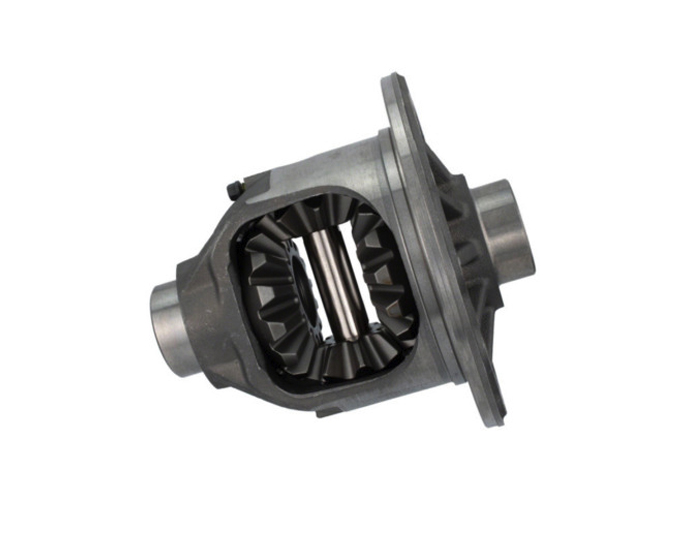
An open differential is used in most passenger vehicles because it is simple, reliable, and effective for everyday driving.
Under normal conditions, such as driving on dry pavement with good traction, an open differential performs its job very well. It allows the outside wheel to rotate faster than the inside wheel during cornering, creating smooth and predictable handling.
For daily driving, this design works perfectly. It is affordable, durable, and requires very little maintenance.
However, an open differential has one major weakness: it struggles when one wheel loses traction.
Why Does an Open Differential Lose Traction?
The problem comes down to a simple principle: engine power follows the path of least resistance.
Think about water flowing downhill. It naturally chooses the easiest path. An open differential works in a similar way when distributing torque between two wheels.
The moment one wheel loses grip, such as when driving on ice, snow, mud, or uneven terrain, that wheel becomes much easier to rotate. The open differential sends more power to the wheel with the least resistance, causing it to spin.
Meanwhile, the wheel that still has traction receives very little usable power.
The result is a common problem many drivers have experienced: one wheel is spinning, but the vehicle is not moving forward.
So how do we solve this problem?
This is where more advanced differential designs come into play — the limited slip differential (LSD) and the locking differential.
What Is a Limited Slip Differential (LSD)?
The limited slip differential, commonly known as LSD, is designed to overcome the biggest weakness of an open differential.

The name explains the basic function. A limited slip differential limits the amount of slip between the two wheels and helps transfer power to the wheel that still has traction.
When an LSD detects that one wheel is rotating much faster than the other, it begins to redirect torque across the axle.
This provides better traction, improved acceleration, and more control in situations where an open differential would allow excessive wheel spin.
Compared with an open differential, an LSD offers a better balance between everyday driving comfort and improved performance.
There are several different ways to create limited slip functionality, but two major mechanical designs are widely used: helical gear LSDs (Torsen-type LSDs) and clutch-type LSDs.
How Does a Helical Gear / Torsen LSD Work?
A helical LSD, also known as a Torsen-type limited slip differential, uses specially designed gears to transfer torque between the wheels.

Unlike clutch-type differentials, a helical LSD does not rely on friction plates. Instead, it uses the interaction between gears to sense torque differences and distribute power to the wheel with better traction.
One of the biggest advantages of a Torsen LSD is its smooth and progressive operation.
Because it uses a gear-based mechanism, it provides quiet performance, requires very little maintenance, and does not have clutch plates that wear out over time.
This makes a helical LSD a popular choice for vehicles that require improved traction while maintaining daily driving comfort.
However, a Torsen LSD also has a specific limitation.
Because it is a torque-sensing differential, it needs resistance from both wheels to transfer torque effectively.
If one wheel is completely lifted off the ground and has zero traction, the system has nothing to work against. In this situation, the Torsen LSD may not be able to transfer power effectively and can behave similarly to an open differential.
What Is a Clutch-Type LSD?
Another common type of limited slip differential is the clutch-type LSD.
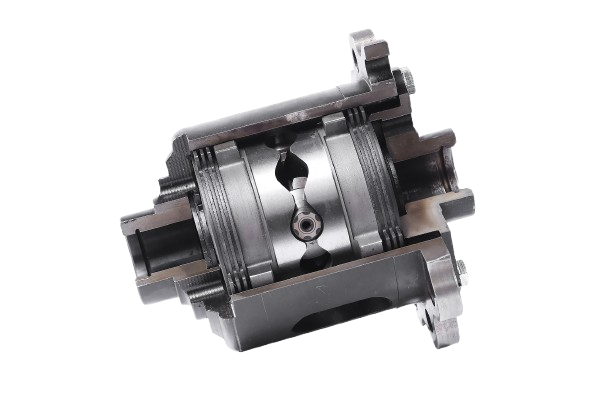
Unlike a helical or Torsen LSD that uses gears to transfer torque, a clutch-type LSD uses friction plates to control the difference in wheel speed.
When one wheel begins to spin faster than the other, the clutch packs engage and create resistance. This allows more torque to be transferred to the wheel that still has traction.
Because of its strong locking effect, a clutch-type LSD is widely used in performance vehicles and racing applications where aggressive acceleration and improved traction are required.
However, because this design depends on friction materials, the clutch plates can wear over time. Depending on the application and driving style, maintenance or replacement of the clutch components may eventually be required.
However, because this design depends on friction materials, the clutch plates can wear over time. Depending on the application and driving style, maintenance or replacement of the clutch components may eventually be required.
What Is a Locking Differential (Locker)?
If a limited slip differential is designed to reduce wheel spin, a locking differential, also called a locker, is designed to provide maximum traction.
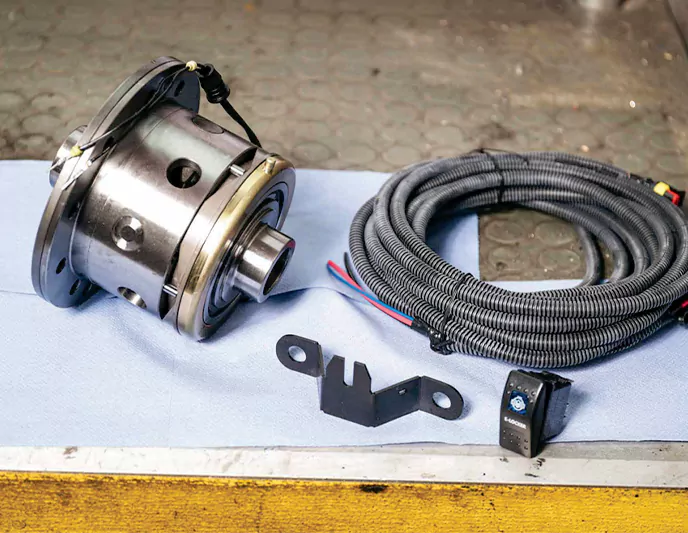
A locker takes a different approach.
Instead of limiting the difference in wheel speed, it mechanically locks both axle shafts together.
When the locker is activated, both wheels on the same axle rotate at the same speed and receive power together.
This means that even if one wheel loses traction, the other wheel can continue providing driving force.
For example, during extreme off-road driving, one wheel may be lifted off the ground while the other wheel remains in contact with the terrain. With an open differential, the vehicle would likely lose forward movement. With a locker, both wheels remain connected and continue transferring power.
This is why locking differentials are widely used in off-road vehicles designed for challenging environments such as mud, sand, rocks, and uneven trails.
Open Differential vs LSD vs Locker
Understanding the difference between an open differential, LSD, and locker becomes easier when looking at real driving situations.
Driving on Ice
Imagine one wheel is sitting on a patch of ice while the other wheel has normal traction.
With an open differential, the wheel on ice will spin because it has the least resistance. The vehicle may struggle to move because most of the available power is being sent to the spinning wheel.
With a limited slip differential, the system detects the difference in wheel speed and transfers more torque to the wheel with traction. This allows the vehicle to move more effectively.
With a locking differential, both wheels are forced to rotate together. Even if one wheel has little or no traction, the other wheel can continue pushing the vehicle forward.
Performance Driving on a Racetrack
The situation changes when driving on a high-grip surface such as a racetrack.
During aggressive cornering, the inside wheel may become lighter and lose traction.
An open differential will allow the inside wheel to spin, wasting engine power and reducing acceleration.
A limited slip differential helps control wheel spin and allows better power delivery when exiting corners.
A locker, however, is not always ideal for performance driving on pavement. Because both wheels are forced to rotate at the same speed, it can affect handling and make the vehicle less flexible during cornering.
This shows that there is no single differential design that is perfect for every situation.
The best choice depends on how the vehicle is used.
Which Differential Is Right for Your Vehicle?
Choosing between an open differential, LSD, and locker depends on your driving environment and performance requirements.
An open differential is suitable for normal daily driving where traction loss is uncommon. It provides reliable operation, smooth handling, and low maintenance.
A limited slip differential (LSD) is a great choice for drivers who want improved traction while maintaining everyday comfort. It works well for performance vehicles, changing weather conditions, and drivers who need better control without the aggressive characteristics of a locker.
A locking differential is designed for situations where maximum traction is required. It is the preferred solution for serious off-road driving, including rock crawling, mud, sand, and other extreme terrain.
Conclusion
The open differential, limited slip differential, and locking differential each have their own advantages and limitations.
Whether you are looking for better acceleration, improved handling, or maximum off-road capability, selecting the correct differential can make a significant difference in vehicle performance.