Note: XJXParts is not related to any product or model code such as ‘xjx-400’, ‘xjx-212’, or other similar terms. Our focus is exclusively on differential and drivetrain technology.

When to Use Diff Locks Off-Road?

There is a particular moment on a difficult climb when you suddenly understand why experienced off-road drivers get so enthusiastic about differential locks
Picture a 4WD crawling slowly uphill. Everything feels controlled until one wheel drops into a rut and becomes lightly loaded—or even lifts slightly. You add a little throttle. That wheel spins, the vehicle stops climbing, and suddenly all that engine power seems to be doing nothing useful.
That is exactly the kind of situation where a differential lock can transform the vehicle.
Stop the wheelspin, select the appropriate drivetrain setting according to your vehicle’s manual, engage the relevant locker, and try the obstacle again with a smooth throttle. Instead of attacking the hill with more speed, the vehicle may simply crawl through.
That is why I sometimes call diff locks “magic buttons.”
They are not actually magic, of course. They are mechanical or electronically controlled traction devices, and understanding what they are locking—and when to use them—is much more important than simply pressing a switch.
The first thing to get right is terminology, because a center differential lock and an axle differential locker do very different jobs.

Center Diff Lock vs Rear Diff Lock

A lot of casual off-road discussion uses the phrase “diff lock” as if every locker performs the same function. It does not.
A conventional axle differential allows the left and right wheels on the same axle to rotate at different speeds. That difference is necessary when turning because the outside wheel travels farther than the inside wheel. Jeep describes an open differential in essentially these terms: it allows left and right wheels to turn at different speeds, while a locking differential couples the two axle shafts so both wheels rotate together.
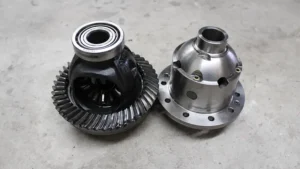
A rear differential locker, therefore, locks the left and right rear wheels together mechanically or electronically so they rotate at the same rate. A front locker does the same thing across the front axle.
A center differential lock is different.
On a full-time 4WD vehicle fitted with a center differential, the center differential normally permits a speed difference between the front and rear driveline. Locking it restricts that difference and couples the front and rear outputs together much more directly. It does not lock the left and right wheels on either axle together. Toyota, for example, distinguishes center-differential-lock modes from its separate rear-locking differential systems, and its full-time 4WD documentation specifically describes center-locked modes for loose or slippery surfaces.
This distinction matters because the original phrase “centre rear diff lock” is technically ambiguous. A vehicle may have a center differential lock, a rear axle locker, both, or neither, depending on its drivetrain. Some vehicles instead use a part-time transfer case that couples the front and rear driveline without having a center differential at all. Jeep notes that part-time 4WD systems can lock the front and rear driveshafts together, which is why they should not be confused with an axle locker.
So before using any switch, know what your vehicle actually has.

What an open differential does when one wheel loses traction?

An open differential works beautifully on normal roads because it lets the wheels turn at different speeds while cornering. Its weakness becomes obvious when one driven wheel has dramatically less traction than the other.
If one wheel is hanging in the air, sitting on slick mud, or unloaded in a deep rut, that low-traction side can spin while the wheel with better grip contributes less usable driving force than you need to keep moving.
That does not mean an open differential literally “sends all the power to the spinning wheel,” which is an oversimplification you will often hear. The more useful way to think about it is that the open differential’s torque relationship can leave the axle unable to develop enough tractive force when one side has very little resistance.
An axle locker changes that situation by mechanically coupling the axle shafts. Both wheels are forced to rotate together, so one wheel can no longer freely run away at a very different speed from the other. Jeep and Ram both describe locking axle differentials as coupling the axle sides together so the wheels rotate at the same rate in demanding low-traction conditions.
That is why the difference can feel so dramatic from behind the wheel.

When Should You Use a Diff Lock Off-Road?

The best time to engage a locker is usually before wheelspin turns the obstacle into a fight.
That is an important off-road habit. Many beginners wait until a tyre is spinning violently, then react with more throttle. In many situations, a better approach is to recognize the terrain early, choose the correct drive mode or low range where appropriate, engage the available traction aids according to the owner’s manual, and approach slowly.
Toyota explicitly advises stopping wheelspin before certain drivetrain changes, while its rear-locker instructions for some models say the wheels should be stopped before locking. The exact procedure varies significantly by vehicle.
Typical situations where a differential lock can be particularly useful include:
  • steep, loose climbs where one or more wheels unload;
  • deep ruts and cross-axle terrain;
  • rocky ledges where a tyre may lift;
  • slow mud driving where wheelspin is stopping progress;
  • loose sand in situations where maintaining controlled forward drive is difficult;
  • uneven ground where suspension articulation runs out and a wheel becomes lightly loaded.
Manufacturers routinely associate locking differentials and low-range drivetrains with exactly these kinds of terrain. Jeep highlights lockers for ruts, loose climbs, rocks, mud and demanding uneven surfaces, while Toyota specifies low-range and locked driveline settings for steep hills, sand, mud and deep snow on appropriate vehicles.

Steep climbs

This is where the “magic button” effect is easiest to demonstrate.

Imagine climbing slowly with the drivetrain unlocked. One rear wheel drops into a hole, unloads and begins spinning. Forward progress stops.

Instead of taking a longer run-up and hitting the hill harder, a suitable rear locker can allow both rear wheels to remain coupled. The tyre that still has meaningful contact with the ground can now contribute more effectively to moving the vehicle.

The real benefit is often not speed but control.

With more usable traction available at low speed, you may be able to reduce throttle input, reduce wheelspin and choose a more precise line. Manufacturer off-road guidance similarly emphasizes low-range gearing and locking differentials as tools for controlled progress over difficult terrain rather than as substitutes for judgement.

Cross-axles, ruts, and wheel lift

Cross-axle situations are classic locker territory.

When opposite corners of the vehicle become heavily loaded while the other two become lightly loaded, open differentials can struggle. A rear or front axle locker can maintain a fixed relationship between the two wheels on that axle and keep the vehicle moving even when one wheel has very little available grip.

This is one reason rock-crawling vehicles so often use selectable lockers. Jeep’s off-road guidance specifically notes that locking differentials help keep drive available when a tyre lifts.

A front locker can add even more traction, but it also affects steering more noticeably because the two front wheels are no longer free to differentiate normally. Ram warns that locked axles reduce turning ability on pavement, while older Jeep technical material similarly notes that locking the front differential can substantially increase the turning circle.

For that reason, many drivers use a rear locker first and only add the front locker when the terrain genuinely requires it.

Mud

A locker can be very effective in mud, but mud is not one single driving problem.

In deep, sticky mud, some wheel speed may be useful for clearing tread. In slow, uneven mud where one tyre repeatedly unloads, an axle locker can dramatically improve forward drive.

The key is to avoid confusing useful tyre rotation with uncontrolled wheelspin. Excessive wheelspin can dig holes, destroy the track surface and increase mechanical shock when a spinning tyre suddenly finds grip.

Toyota’s stuck-vehicle guidance specifically warns against excessive wheelspin and excessive accelerator input because of the risk of component damage.

Sand

Sand requires a little more judgement.

A locker can help when one wheel keeps spinning and forward drive is being lost, especially on uneven dunes, washouts or soft climbs. But momentum, tyre pressure, throttle smoothness and line choice can be equally important.

Toyota’s 4WD documentation lists sand among the conditions where low-range or locked drivetrain settings may be appropriate on relevant models, while its terrain-control systems may deliberately allow different amounts of wheel slip depending on surface conditions.

There is no universal “always lock the diff in sand” rule. Your vehicle configuration, tyre setup and terrain matter.

Rock crawling

This is one of the strongest use cases for lockers.

Slow rock crawling frequently creates situations where one tyre is airborne or carries almost no weight. A locker allows the wheel that remains planted to continue contributing useful driving force rather than relying entirely on momentum.

That supports a much calmer technique: lower speed, deliberate wheel placement and smaller throttle inputs. Jeep’s current technical guidance explicitly connects locking differentials with rock crawling and with maintaining traction when a tyre lifts.
Conclusion

Differential locks are among the most useful tools a properly equipped 4WD can have, but the real skill is knowing what you are locking, why you are locking it, and when to unlock it again.
Use them to create traction, not bravado.
Slow down. Read the terrain. Engage the appropriate system before unnecessary wheelspin where your manufacturer’s procedure permits it. Let the tyres work. Keep the throttle smooth. And remember that the switch marked DIFF LOCK is not a substitute for a good line or good judgement.
Save this guide for your next off-road trip—you will probably appreciate it the first time the trail gets properly crossed up.

Don’t Stop Here

More To Explore

4H vs 4L

4H vs 4L, What’s the Difference?

If you’ve ever driven a 4WD truck or SUV, you’ve probably noticed the 2H, 4H, and 4L settings near the gear selector. Most drivers know

OEM vs Aftermarket Differential Locker

OEM vs Aftermarket Differential Locker

If you’re shopping for a rear differential locker, you’ve probably come across two terms: OEM and aftermarket. At first glance, the difference seems simple. One

download catalog now!