Center Diff Lock vs Rear Diff Lock
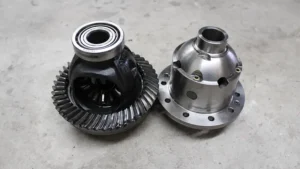
What an open differential does when one wheel loses traction?
When Should You Use a Diff Lock Off-Road?
- steep, loose climbs where one or more wheels unload;
- deep ruts and cross-axle terrain;
- rocky ledges where a tyre may lift;
- slow mud driving where wheelspin is stopping progress;
- loose sand in situations where maintaining controlled forward drive is difficult;
- uneven ground where suspension articulation runs out and a wheel becomes lightly loaded.
Steep climbs
This is where the “magic button” effect is easiest to demonstrate.
Imagine climbing slowly with the drivetrain unlocked. One rear wheel drops into a hole, unloads and begins spinning. Forward progress stops.
Instead of taking a longer run-up and hitting the hill harder, a suitable rear locker can allow both rear wheels to remain coupled. The tyre that still has meaningful contact with the ground can now contribute more effectively to moving the vehicle.
The real benefit is often not speed but control.
With more usable traction available at low speed, you may be able to reduce throttle input, reduce wheelspin and choose a more precise line. Manufacturer off-road guidance similarly emphasizes low-range gearing and locking differentials as tools for controlled progress over difficult terrain rather than as substitutes for judgement.
Cross-axles, ruts, and wheel lift
Cross-axle situations are classic locker territory.
When opposite corners of the vehicle become heavily loaded while the other two become lightly loaded, open differentials can struggle. A rear or front axle locker can maintain a fixed relationship between the two wheels on that axle and keep the vehicle moving even when one wheel has very little available grip.
This is one reason rock-crawling vehicles so often use selectable lockers. Jeep’s off-road guidance specifically notes that locking differentials help keep drive available when a tyre lifts.
A front locker can add even more traction, but it also affects steering more noticeably because the two front wheels are no longer free to differentiate normally. Ram warns that locked axles reduce turning ability on pavement, while older Jeep technical material similarly notes that locking the front differential can substantially increase the turning circle.
For that reason, many drivers use a rear locker first and only add the front locker when the terrain genuinely requires it.
Mud
A locker can be very effective in mud, but mud is not one single driving problem.
In deep, sticky mud, some wheel speed may be useful for clearing tread. In slow, uneven mud where one tyre repeatedly unloads, an axle locker can dramatically improve forward drive.
The key is to avoid confusing useful tyre rotation with uncontrolled wheelspin. Excessive wheelspin can dig holes, destroy the track surface and increase mechanical shock when a spinning tyre suddenly finds grip.
Toyota’s stuck-vehicle guidance specifically warns against excessive wheelspin and excessive accelerator input because of the risk of component damage.
Sand
Sand requires a little more judgement.
A locker can help when one wheel keeps spinning and forward drive is being lost, especially on uneven dunes, washouts or soft climbs. But momentum, tyre pressure, throttle smoothness and line choice can be equally important.
Toyota’s 4WD documentation lists sand among the conditions where low-range or locked drivetrain settings may be appropriate on relevant models, while its terrain-control systems may deliberately allow different amounts of wheel slip depending on surface conditions.
There is no universal “always lock the diff in sand” rule. Your vehicle configuration, tyre setup and terrain matter.
Rock crawling
This is one of the strongest use cases for lockers.
Slow rock crawling frequently creates situations where one tyre is airborne or carries almost no weight. A locker allows the wheel that remains planted to continue contributing useful driving force rather than relying entirely on momentum.
That supports a much calmer technique: lower speed, deliberate wheel placement and smaller throttle inputs. Jeep’s current technical guidance explicitly connects locking differentials with rock crawling and with maintaining traction when a tyre lifts.